
About This Agent
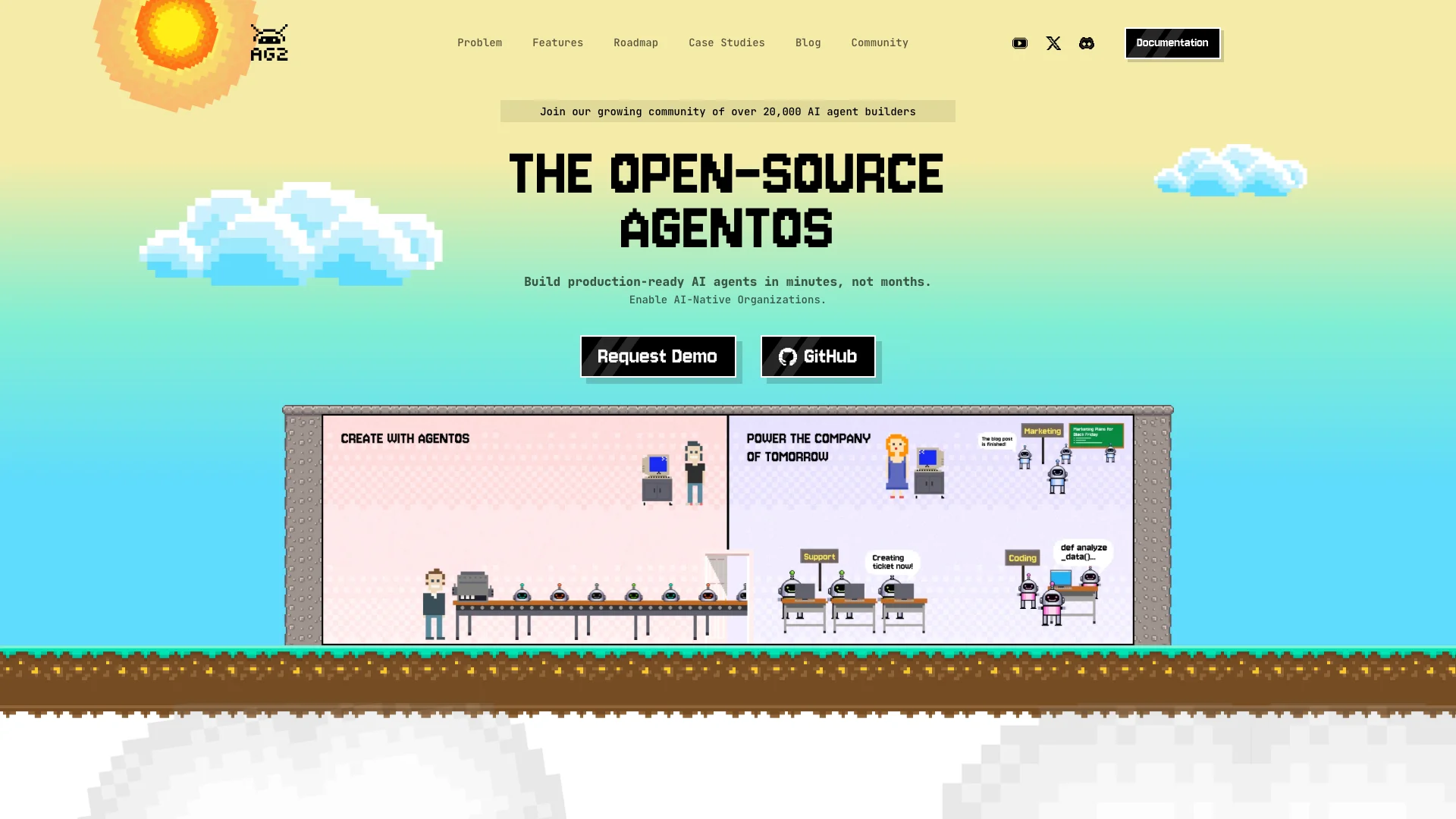
The website listed for AgentOS is AG2, an open-source Python framework for building and orchestrating multi-agent systems. Official pages say AG2 comes from the creators of AutoGen and is meant for production-style agent orchestration, including later packaging that brings people and AI teammates into shared rooms. The directory still uses the name AgentOS, which does not match the current public brand, so a reviewer should confirm the listing name, slug, and website before publishing. AG2 is an agent-orchestration framework, not an enterprise-operations or digital-workforce suite, and belongs with agentic foundations.
Agent Capabilities
- Role-based agent specialization: Assistant, Executor, and Critic agents with distinct responsibilities for reasoning, action, and validation.
- Automated coordination engine that dynamically assigns tasks and manages dependencies without human intervention.
- Dynamic group chat management enabling real-time collaboration among multiple agents on shared objectives.
- Sequential conversation support for structured, step-by-step process execution with clear state transitions.
- Nested conversations that allow sub-agents to handle subtasks while preserving full context and traceability.
- Configurable human input points for approvals, clarifications, or strategic decisions at any stage of the workflow.
- Flexible intervention mechanisms that let operators pause, redirect, or override agent actions with minimal friction.
- Scalable runtime designed for concurrent agent sessions across enterprise-grade workloads.
Primary Workflows & Use Cases
- Cross-border e-commerce catalog management: Automate multilingual product descriptions, pricing updates, and compliance checks across regional marketplaces.
- Performance creative testing: Generate ad copy and visual variants, run A/B tests, and have critic agents refine underperforming creatives in real time.
- Automated outbound sales: Orchestrate prospect research, personalized email drafting, and follow-up scheduling with human approval at key deal stages.
- Software engineering pipelines: Coordinate code generation, automated code review, and test execution across multiple agents to accelerate feature delivery.
- Customer care triage: Route inquiries through assistant agents, escalate to executor agents for resolution, and use critic agents to ensure policy compliance.
Similar Agentic Foundations & Multi-Agent Orchestration Agents
Explore alternatives and related autonomous systems in this category.
 MetaGPT
 is an open-source multi-agent framework that simulates a software company: a team of agents takes a natural-language requirement and produces artifacts such as plans, documents, and code. The public GitHub project, now under FoundationAgents, presents it as a framework for multi-agent collaboration and natural-language programming rather than as a hosted IDE. Researchers and developers use it to experiment with role-based agent teams, not to replace a production no-code app builder on its own. MetaGPT belongs with agentic foundations and orchestration, even though its demo domain is software delivery.
 xpander.ai
 is an enterprise platform for running and governing AI agents and coding tools in an organization’s own environment. Official pages describe an AI gateway, an MCP gateway, an agent runtime, and a workspace, including support for running popular coding agents in the customer’s cloud under one policy. Teams keep the tools they already use while IT keeps a single place for access, routing, and policy. That combination of gateway and runtime is agent infrastructure, not a generic digital-workforce product. xpander.ai belongs with agentic foundations.
 TinyFish
 is web infrastructure for AI agents that need to search, extract, browse, and act on live websites. Official pages describe an enterprise, serverless platform for navigating sites, authenticating, extracting data, and automating web workflows, including monitoring pages for changes. Developers use it as the web stack behind their agents rather than as a human operations console. TinyFish is a runtime and data layer for agents and belongs with agentic foundations. Official examples include monitoring live pages for price or content changes and then alerting an agent or team.
KaibanJS is a JavaScript framework for building multi-agent systems. Official materials describe managing agents with a Kanban-style board so developers can see and organize multi-agent runs in a way that feels familiar if they have used tools such as Trello or Jira. You define agents and their work in code, then watch those runs move across the board as they proceed. It is a programming library and visual board for agent orchestration in JavaScript applications, not a business-operations or digital-workforce product. KaibanJS belongs with agentic foundations, where other agent frameworks and orchestration tools are listed.
Community & Channels
Are you the author of AgentOS? Claim your official badge.