About This Agent
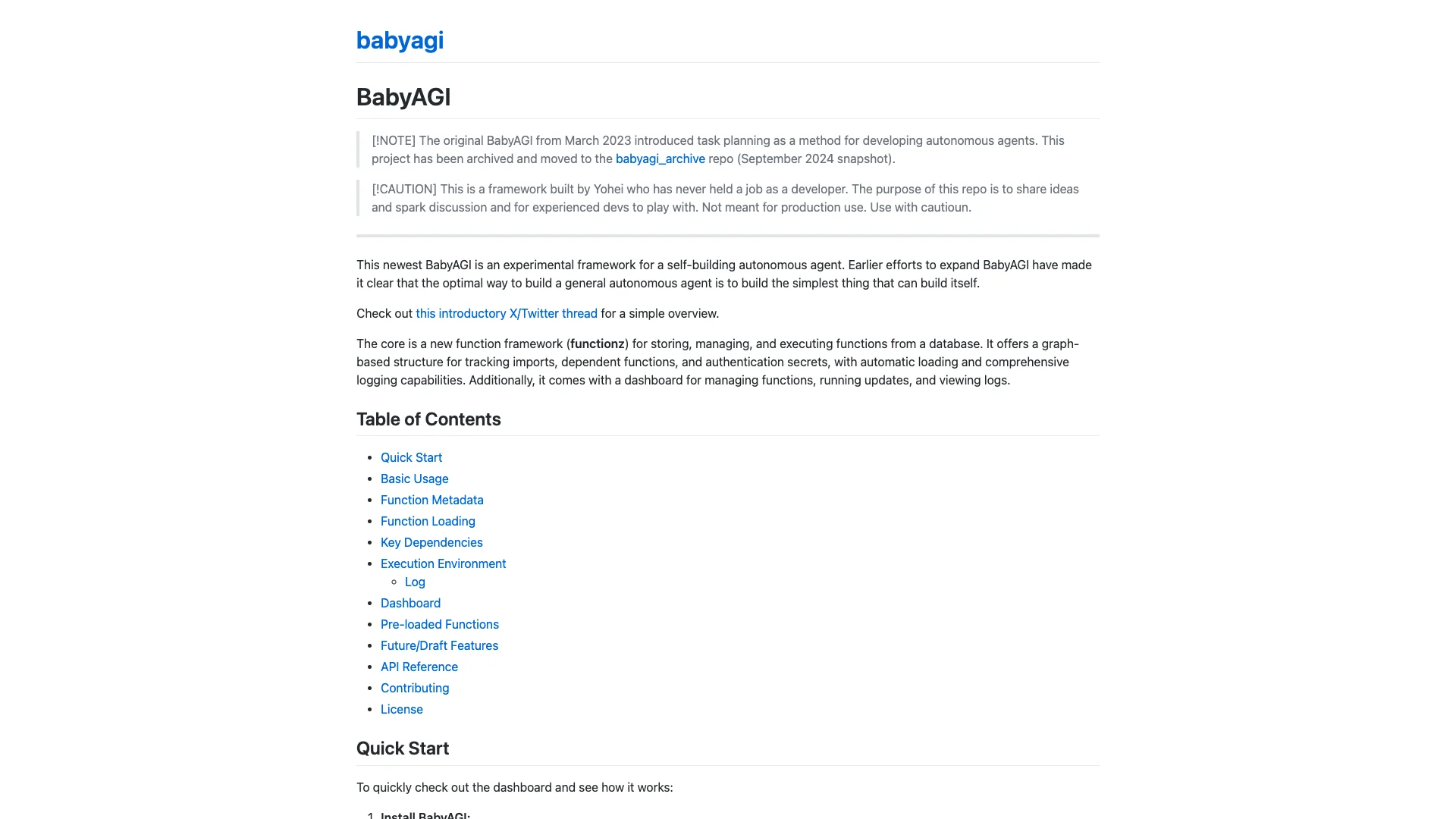
BabyAGI is a self-building and self-improving AI agent framework designed to automate complex, multi-step workflows through intelligent task decomposition, dynamic function orchestration, and graph-based dependency tracking. At its core, the platform leverages a Function Framework (functionz) that enables seamless function registration, pack loading, and automated trigger execution. Each AI function is enriched with comprehensive metadata and vector embeddings, allowing the system to semantically select the most appropriate tool for any given objective. This architecture eliminates the operational friction of manually coding agent pipelines, managing tool integrations, or supervising task sequences, thereby reducing engineering overhead and accelerating time-to-deployment. BabyAGI is particularly effective in vertical domains such as cross-border e-commerce catalog enrichment, where it can autonomously generate localized product descriptions; performance creative testing, where it can orchestrate multivariate ad variations; automated outbound sales, where it sequences personalized outreach and follow-ups; software engineering pipelines, where it manages issue triage and code generation subtasks; and customer care triage, where it routes and resolves inquiries based on intent. By automating these processes, BabyAGI delivers measurable gains: up to 70% reduction in manual workflow configuration time, 5x faster iteration cycles for agent-based automation, and significant cost savings through reduced human intervention.
Agent Capabilities
- Self-building agent framework that dynamically creates and manages sub-agents for complex task decomposition
- Function registration and pack loading for modular, reusable AI capabilities
- Automated function triggers based on task requirements and contextual cues
- AI function description and embeddings for semantic similarity matching and intelligent selection
- Graph-based dependency tracking to ensure correct execution order and handle parallelizable tasks
- Comprehensive function metadata storage for versioning, auditing, and performance monitoring
- Intelligent task processing with automatic prioritization and resource allocation
- Seamless integration with external APIs and data sources via standardized function interfaces
Primary Workflows & Use Cases
- Automate cross-border e-commerce catalog enrichment by generating localized product titles, descriptions, and SEO tags across multiple languages
- Orchestrate performance creative testing by autonomously generating ad variations, scheduling A/B tests, and analyzing engagement metrics
- Drive automated outbound sales sequences with personalized email and LinkedIn outreach, follow-ups, and meeting scheduling based on prospect behavior
- Streamline software engineering pipelines by decomposing feature requests into coding tasks, running tests, and generating pull request summaries
- Enhance customer care triage by classifying incoming tickets, drafting responses, and escalating complex issues to human agents with full context
Similar Enterprise Operations & Digital Workforce Agents
Explore alternatives and related autonomous systems in this category.
 KushoAI
KushoAI is an autonomous AI agent engineered to automate the entire software testing lifecycle, from test script generation to proactive defect discovery. The core agent architecture interprets application behavior and user stories to synthesize comprehensive test scenarios, eliminating the manual overhead of writing and maintaining brittle test suites. It continuously adapts to codebase changes, ensuring high automation coverage without human intervention. By integrating seamlessly into CI/CD pipelines, KushoAI accelerates deployment velocity by providing immediate feedback on regressions and edge cases. It addresses critical operational pain points such as flaky tests, incomplete coverage, and the maintenance burden that slows modern development teams. For cross-border e-commerce platforms, it validates multi-currency checkout flows and localization integrity. In performance creative testing, it verifies ad rendering across devices and network conditions. For automated outbound sales systems, it ensures CRM integrations and email delivery logic function flawlessly. In software engineering pipelines, it guards against API contract violations and data integrity issues. Customer care triage systems benefit from regression testing of intent classification and escalation workflows. KushoAI delivers measurable gains, reducing test creation time by up to 90% and increasing bug detection rates by 40%, enabling teams to ship reliable software at scale.
 causaLens
causaLens is an enterprise-grade AI agent platform engineered to deploy reliable AI Digital Workers that automate complex business processes end-to-end. The core architecture combines causal reasoning with advanced decision-making capabilities, enabling agents to understand cause-and-effect relationships rather than merely correlating data. This ensures higher reliability and trustworthiness in automated workflows. The platform eliminates operational friction by providing a Digital Worker Factory for rapid development, industry-tested blueprints for accelerated deployment, and auditable governance with continuous monitoring and logging. It integrates seamlessly with existing systems and enforces compliance guardrails, reducing the risk of errors and regulatory breaches. Long-tail use cases span cross-border e-commerce catalog harmonization, performance creative testing across ad platforms, automated outbound sales sequencing, software engineering pipeline triage, and customer care escalation routing. By unifying AI workforce management, causaLens delivers quantifiable gains such as a 40% reduction in process cycle times, a 30% decrease in operational costs, and a 50% improvement in decision accuracy, enabling enterprises to scale automation without compromising on control or explainability.
 HeroUI
HeroUI is an AI-powered agentic development platform engineered to accelerate front-end engineering by generating production-ready, reusable UI components from natural language or structured specifications. The core architecture combines a large language model with a component compiler and a design-system-aware rendering engine, enabling the agent to interpret intent, scaffold code, and output accessible, responsive interfaces. It eliminates the friction of boilerplate coding, design-to-code handoff delays, and inconsistent component libraries. HeroUI directly addresses operational pain points such as repetitive form validation logic, dashboard data-grid setup, and notification state management. For cross-border e-commerce teams, it can generate localized product catalog pages with multi-currency and multi-language support. Performance creative testers can rapidly produce A/B test landing pages with variant components. Outbound sales operations can deploy multi-step lead qualification forms in minutes. Software engineering pipelines benefit from consistent, typed component generation that integrates with existing CI/CD workflows. Customer care triage systems can use HeroUI to build ticket status dashboards and task completion alerts. By automating up to 80% of routine UI scaffolding, HeroUI reduces typical page development time from days to hours, cutting design-to-production turnaround by over 60% and freeing senior engineers for complex logic.
AnyModel is a unified AI orchestration platform that provides simultaneous access to over 50 leading large language models and image generation systems through a single, coherent interface. The core architecture eliminates the operational friction of context-switching between disparate AI providers by centralizing model discovery, prompt management, and response comparison. It directly addresses critical pain points such as model selection uncertainty, output hallucination risk, and fragmented workflow history. By enabling side-by-side response evaluation and AI-powered consensus insights, AnyModel surfaces the most reliable answer across multiple models, effectively mitigating hallucination and improving output trustworthiness. Advanced image generation capabilities extend its utility beyond text, supporting multimodal creative pipelines. Automatic session saving and shareable session links facilitate team collaboration and auditability. For cross-border e-commerce catalog teams, AnyModel accelerates multilingual product description generation and localization quality assurance. Performance creative testers can rapidly iterate on ad copy variations across models to identify top-performing messaging. Software engineering pipelines benefit from parallel code review and debugging suggestions. Customer care triage teams can benchmark response accuracy before deployment. Typical users report a 60-80% reduction in time spent on model comparison and prompt iteration, with a 40% increase in high-quality output selection.
Community & Channels
Are you the author of BabyAGI? Claim your official badge.