
About This Agent
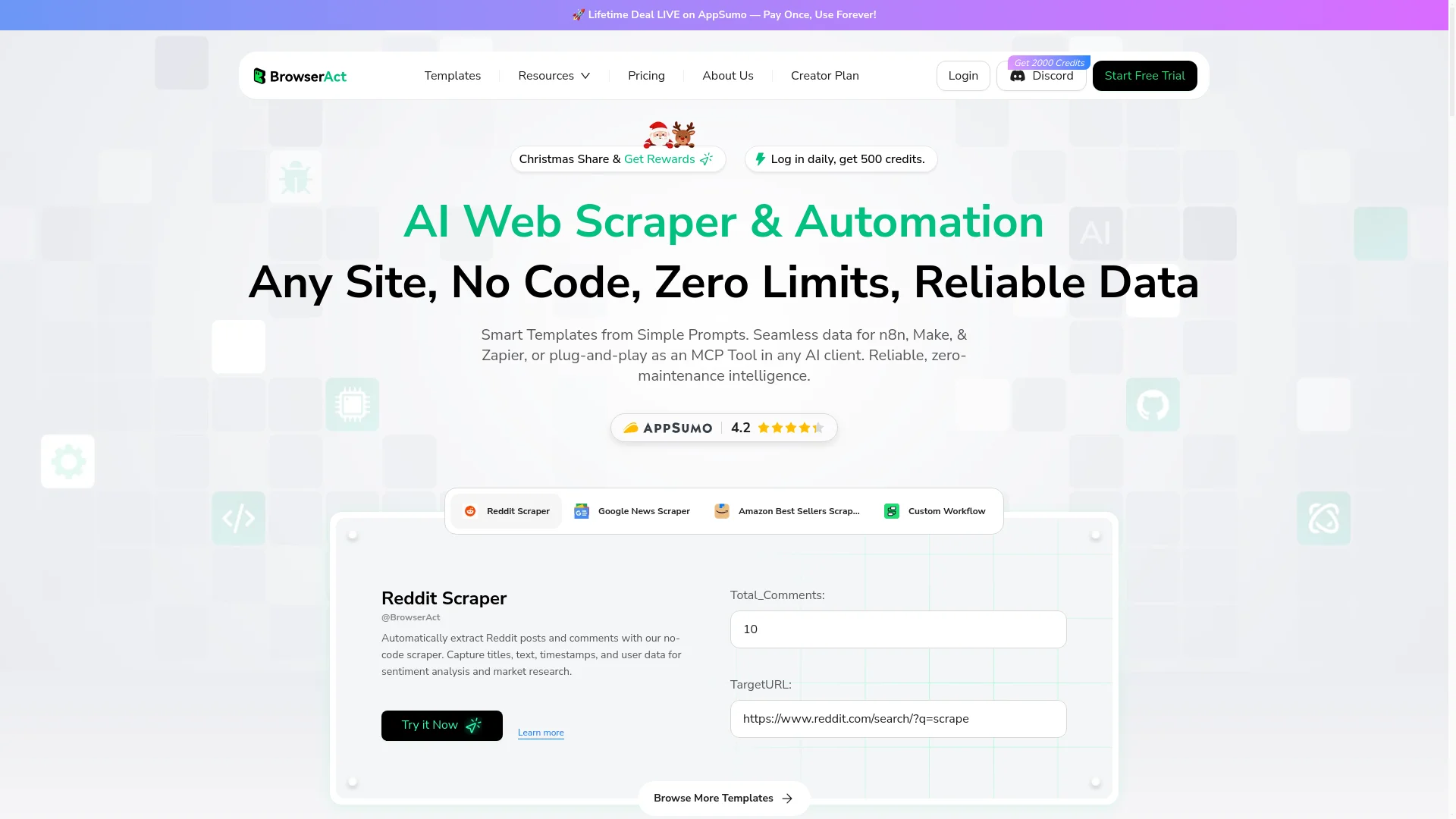
BrowserAct is an AI-powered browser automation platform that enables non-technical users to orchestrate complex web tasks through natural language instructions, eliminating the need for custom scripting. Its core architecture combines a simplified node-based workflow designer with AI prompt validation and conditional logic, allowing for dynamic, multi-step automations that adapt to real-time page states. The platform operates on a 24/7 cloud infrastructure, ensuring continuous execution and reliable data extraction from any website, even those with sophisticated anti-bot measures, thanks to an intelligent anti-detection system. BrowserAct addresses critical operational friction points such as manual data scraping, repetitive form submissions, and cross-platform monitoring, which traditionally consume significant engineering resources. It delivers clean, structured data outputs that integrate seamlessly with popular workflow tools and supports the Model Context Protocol (MCP) for extended AI ecosystem interoperability. Concrete use cases include automating cross-border e-commerce catalog enrichment, conducting performance creative testing across ad platforms, powering automated outbound sales prospecting, streamlining software engineering pipeline checks, and triaging customer care tickets. By shifting from code-centric to intent-centric automation, BrowserAct reduces task turnaround times by up to 90% and cuts operational overhead by an estimated 70%, enabling teams to focus on strategic analysis rather than manual browsing.
Agent Capabilities
- AI-powered no-code automation translates plain English instructions into executable browser workflows
- 24/7 cloud-based execution ensures continuous task completion without local infrastructure dependencies
- Clean and reliable data output with schema validation and structured formatting for downstream consumption
- Intelligent anti-detection system mimics human interaction patterns to bypass bot mitigation measures
- Simplified node architecture reduces workflow complexity while maintaining granular control
- AI prompt validation catches ambiguous or incomplete instructions before execution to prevent errors
- Conditional logic nodes enable dynamic branching based on page content, user input, or external data
- Automated multi-level data extraction handles pagination, nested elements, and dynamic content loading
- Broad workflow tool integration connects with Zapier, Make, and custom REST APIs for end-to-end process automation
- AI ecosystem (MCP) support allows seamless integration with AI assistants and retrieval-augmented generation pipelines
Primary Workflows & Use Cases
- Automate cross-border e-commerce catalog synchronization by extracting product details, pricing, and inventory from supplier sites into a unified database
- Run performance creative testing by automatically capturing ad variations, engagement metrics, and landing page elements across multiple platforms
- Power automated outbound sales prospecting by enriching lead lists with contact information, company news, and technographic data from public web sources
- Streamline software engineering pipelines by monitoring CI/CD dashboards, issue trackers, and release notes to generate daily status reports
- Triage customer care tickets by extracting order history, shipping status, and return policies from support portals to pre-populate resolution workflows
Similar Enterprise Operations & Digital Workforce Agents
Explore alternatives and related autonomous systems in this category.
 Melaya
 is a platform for building and running AI agents across business tools, browsers and Android apps: - Melaya Agents: A visual builder for workflows and multi-agent teams. Combines models, tools, memory, schedules and approval steps in replayable runs. - Melaya Assistant: One conversational workspace for working across connected business systems, using approved tools and shared context. - Melaya Device Control: AI agents that operate real Android apps through accessibility, without root or a dedicated API integration. - Melaya Browser Control: Agents that navigate and act inside your browser, with selected tabs, site permissions, live observation and manual takeover. - Melaya MCP Server: Gives existing AI assistants including Claude, ChatGPT and Cursor, access to Melaya’s tools, browser control, mobile agents and workflows through one connection. - Melaya Marketing: A unified suite for AI SEO audits, backlink building, advertising, analytics and a marketing copilot
 KushoAI
 is an autonomous AI agent engineered to automate the entire software testing lifecycle, from test script generation to proactive defect discovery. The core agent architecture interprets application behavior and user stories to synthesize comprehensive test scenarios, eliminating the manual overhead of writing and maintaining brittle test suites. It continuously adapts to codebase changes, ensuring high automation coverage without human intervention. By integrating seamlessly into CI/CD pipelines, KushoAI accelerates deployment velocity by providing immediate feedback on regressions and edge cases. It addresses critical operational pain points such as flaky tests, incomplete coverage, and the maintenance burden that slows modern development teams. For cross-border e-commerce platforms, it validates multi-currency checkout flows and localization integrity. In performance creative testing, it verifies ad rendering across devices and network conditions. For automated outbound sales systems, it ensures CRM integrations and email delivery logic function flawlessly. In software engineering pipelines, it guards against API contract violations and data integrity issues. Customer care triage systems benefit from regression testing of intent classification and escalation workflows. KushoAI delivers measurable gains, reducing test creation time by up to 90% and increasing bug detection rates by 40%, enabling teams to ship reliable software at scale.
 causaLens
 is an enterprise-grade AI agent platform engineered to deploy reliable AI Digital Workers that automate complex business processes end-to-end. The core architecture combines causal reasoning with advanced decision-making capabilities, enabling agents to understand cause-and-effect relationships rather than merely correlating data. This ensures higher reliability and trustworthiness in automated workflows. The platform eliminates operational friction by providing a Digital Worker Factory for rapid development, industry-tested blueprints for accelerated deployment, and auditable governance with continuous monitoring and logging. It integrates seamlessly with existing systems and enforces compliance guardrails, reducing the risk of errors and regulatory breaches. Long-tail use cases span cross-border e-commerce catalog harmonization, performance creative testing across ad platforms, automated outbound sales sequencing, software engineering pipeline triage, and customer care escalation routing. By unifying AI workforce management, causaLens delivers quantifiable gains such as a 40% reduction in process cycle times, a 30% decrease in operational costs, and a 50% improvement in decision accuracy, enabling enterprises to scale automation without compromising on control or explainability.
 HeroUI
 is an AI-powered agentic development platform engineered to accelerate front-end engineering by generating production-ready, reusable UI components from natural language or structured specifications. The core architecture combines a large language model with a component compiler and a design-system-aware rendering engine, enabling the agent to interpret intent, scaffold code, and output accessible, responsive interfaces. It eliminates the friction of boilerplate coding, design-to-code handoff delays, and inconsistent component libraries. HeroUI directly addresses operational pain points such as repetitive form validation logic, dashboard data-grid setup, and notification state management. For cross-border e-commerce teams, it can generate localized product catalog pages with multi-currency and multi-language support. Performance creative testers can rapidly produce A/B test landing pages with variant components. Outbound sales operations can deploy multi-step lead qualification forms in minutes. Software engineering pipelines benefit from consistent, typed component generation that integrates with existing CI/CD workflows. Customer care triage systems can use HeroUI to build ticket status dashboards and task completion alerts. By automating up to 80% of routine UI scaffolding, HeroUI reduces typical page development time from days to hours, cutting design-to-production turnaround by over 60% and freeing senior engineers for complex logic.
Community & Channels
Are you the author of BrowserAct? Claim your official badge.