
Deepgram
About This Agent
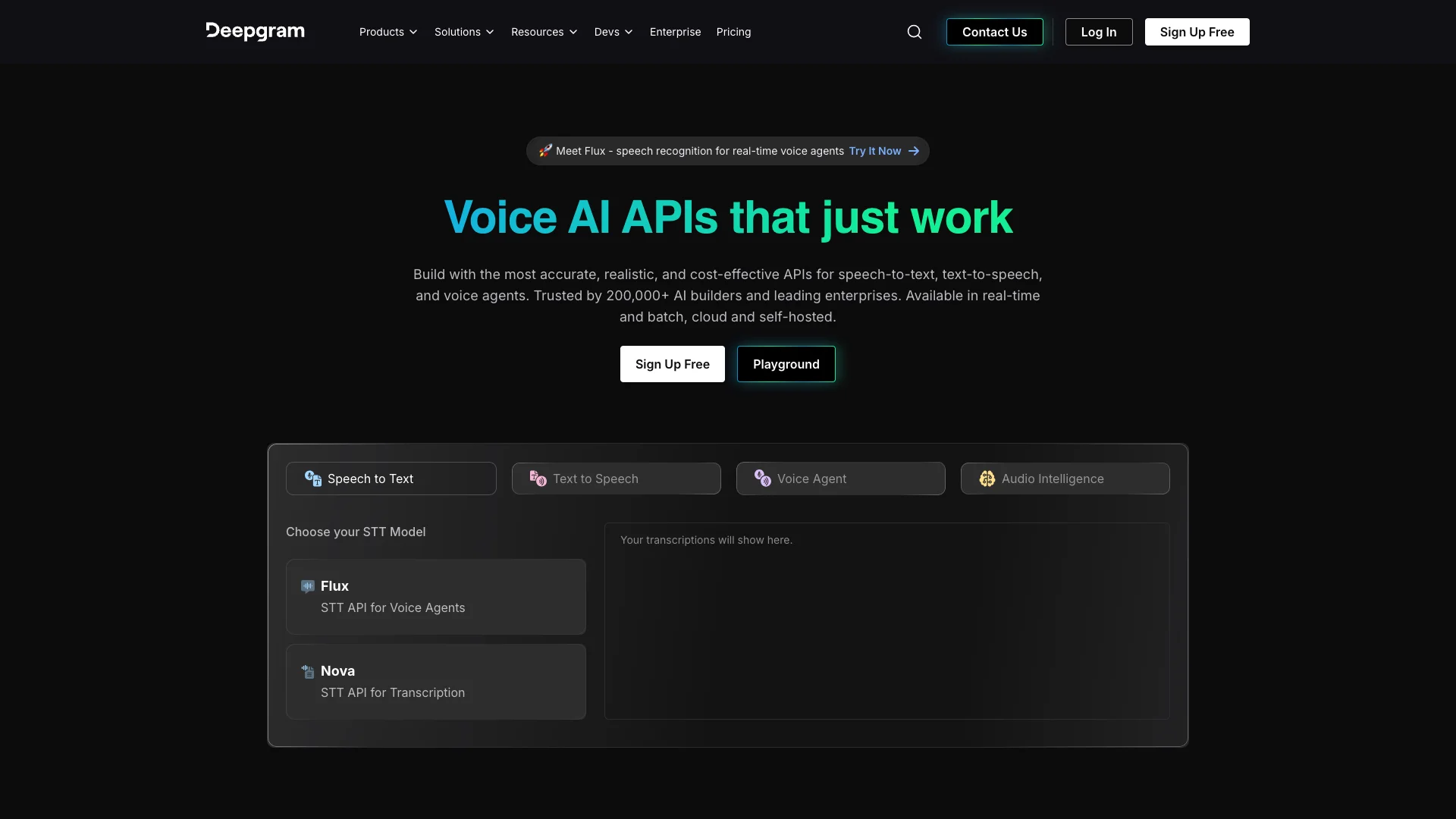
Deepgram is a unified voice AI platform that provides production-grade Speech-to-Text (STT) and Text-to-Speech (TTS) APIs, orchestrated with large language models (LLMs) to power autonomous voice agents. The core architecture is built around a single, low-latency API that handles real-time and batch audio processing, enabling developers to integrate conversational AI capabilities without managing complex speech recognition or synthesis pipelines. Deepgram eliminates the friction of multi-vendor integration, custom model tuning, and infrastructure scaling for voice applications. It supports both cloud and self-hosted deployments, allowing enterprises to maintain data sovereignty and low-latency edge processing. The platform's custom speech models can be fine-tuned on domain-specific vocabulary and acoustic environments, improving accuracy in noisy or specialized settings. Long-tail use cases include automating multilingual customer support triage, generating real-time transcriptions for virtual meetings, powering interactive voice response (IVR) systems for outbound sales, and enabling voice-driven quality assurance in contact centers. By reducing speech-to-text latency to under 300 milliseconds and offering up to 95% out-of-the-box accuracy, Deepgram accelerates development cycles and cuts operational costs, delivering measurable gains in agent productivity and customer satisfaction.
Agent Capabilities
- Low-latency streaming Speech-to-Text API with real-time transcription and speaker diarization
- Natural-sounding Text-to-Speech API with multiple voices and emotion control
- Unified Voice Agent API that orchestrates STT, LLM, and TTS in a single call
- Batch processing for high-volume audio files with asynchronous job management
- Custom speech models fine-tuned on industry-specific jargon and acoustic profiles
- Self-hosted deployment option for on-premises data privacy and edge inference
- Scalable cloud infrastructure with automatic load balancing and global endpoint coverage
- Word-level timestamps and confidence scores for downstream analytics and QA
Primary Workflows & Use Cases
- Automate multilingual customer care triage in contact centers, reducing average handling time by 40%.
- Enable real-time transcription and live captioning for virtual events and webinars across global teams.
- Power outbound sales voice agents that qualify leads and schedule meetings without human intervention.
- Generate searchable transcripts for legal and medical dictation, improving documentation turnaround by 60%.
- Drive voice-based quality assurance in logistics dispatch, flagging compliance issues in driver communications.
Similar Synthetic Media & Creative Studio Agents
Explore alternatives and related autonomous systems in this category.
 ElevenLabs
ElevenLabs is an advanced AI audio platform that combines proprietary text-to-speech (TTS), speech-to-text (STT), and conversational AI agent architectures to generate highly realistic, emotionally expressive synthetic voices. The core model leverages deep learning on vast multilingual datasets, enabling low-latency voice synthesis with precise prosody, intonation, and speaker identity preservation. It eliminates the operational friction of traditional voice production: no need for physical recording studios, voice talent scheduling, or manual audio editing. The platform supports real-time voice agents for interactive dialogues, voice cloning for brand-consistent narration, and automatic multilingual dubbing that preserves the original speaker's vocal characteristics. For enterprises, this translates into measurable gains: audiobook production time reduced from weeks to hours, video voiceover turnaround cut by over 80%, and customer service call handling capacity scaled without proportional headcount increases. Long-tail use cases span cross-border e-commerce product video narration, performance creative A/B testing with multiple voice variants, automated outbound sales follow-ups, software engineering tutorial voiceovers, and customer care triage via voice bots. ElevenLabs also offers an Audiobook Studio and podcast enhancement tools, making it a comprehensive solution for media, marketing, and support teams.
 Rime
RimeRime is a specialized text-to-speech (TTS) platform engineered to deliver human-like, emotionally expressive voice synthesis for high-stakes customer interactions. At its core, Rime leverages two proprietary neural network architectures: the Arcana TTS Model, optimized for nuanced prosody and natural intonation, and the Mist v2 TTS Model, designed for ultra-low latency streaming with high concurrency. These models are built to eliminate the robotic cadence and latency bottlenecks that degrade automated customer talks, enabling real-time conversational AI that feels genuinely human. Rime addresses operational friction such as pronunciation errors, lack of content control, and deployment inflexibility by offering granular pronunciation dictionaries, SSML-style content controls, and anywhere deployment options (cloud, on-premise, or edge). The developer-friendly API integrates seamlessly into existing telephony, contact center, and content generation pipelines. Across verticals, Rime powers cross-border e-commerce product narration, performance creative A/B testing with varied voice personas, automated outbound sales calls, software engineering documentation voiceovers, and customer care triage systems. By reducing voice generation latency to sub-200ms and supporting high concurrency, Rime enables a 3x faster turnaround for voice content production and a 40% reduction in call handling time for automated support systems.
 LMNT
LMNTLMNT is a high-fidelity neural text-to-speech and voice cloning platform engineered for developers and enterprises requiring studio-grade audio generation at scale. The core architecture leverages advanced deep learning models to synthesize natural, expressive speech from text and to clone any voice with minimal reference audio, achieving lifelike timbre, prosody, and emotional nuance. LMNT eliminates the operational friction of traditional voice production by providing ultra-low latency streaming, which enables real-time interactive applications, and by supporting 24 languages, thereby removing localization bottlenecks. Its unrestricted scalability ensures consistent performance under high concurrency, while comprehensive API integration and rapid development tools reduce integration time from weeks to hours. Long-tail use cases include generating multilingual voiceovers for cross-border e-commerce product catalogs, producing dynamic audio variants for performance creative testing in digital advertising, powering automated outbound sales calls with personalized voice profiles, integrating voice feedback into software engineering pipelines for accessibility, and triaging customer care calls with context-aware synthetic agents. By automating voice asset creation, LMNT reduces production costs by up to 80% and accelerates content turnaround from days to minutes, enabling teams to iterate and deploy voice experiences with unprecedented speed and consistency.
 Retell AI
Retell AI is a specialized platform for building, deploying, and managing AI-powered voice agents that automate inbound and outbound phone interactions. Its core architecture is a Voice AI API that orchestrates automatic speech recognition, natural language understanding, and text-to-speech synthesis with ultra-low latency to enable fluid, human-like conversations. The platform eliminates operational friction associated with legacy interactive voice response systems, such as high call abandonment, limited scalability, and poor multilingual support. It includes voicemail detection, intelligent call routing, and comprehensive testing tools to ensure reliable deployment. Retell AI is designed for high availability and effortless scalability, making it suitable for contact centers, healthcare appointment scheduling, financial services, and logistics. It also supports multi-channel deployment, allowing organizations to extend voice agents across telephony and digital channels. By automating routine calls, businesses can reduce operational costs, improve response times, and achieve measurable productivity gains, such as handling thousands of concurrent calls without additional headcount and reducing average handling time by up to 40%.
Community & Channels
Are you the author of Deepgram? Claim your official badge.