About This Agent
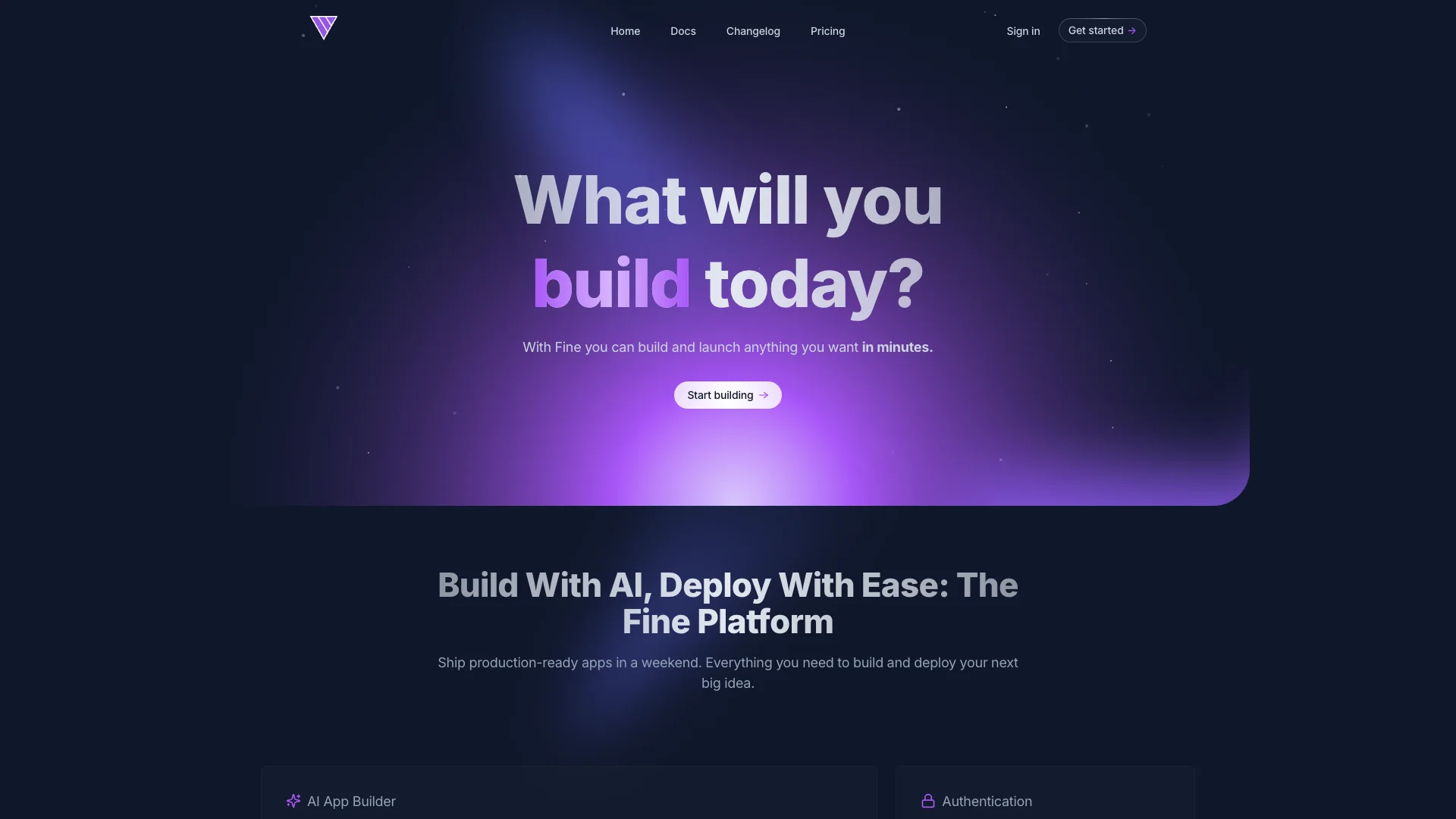
Fine is an AI software-development platform whose agents can take work from GitHub or issue trackers such as Linear or Jira, work in a cloud environment, and open pull requests. Public docs and product pages describe tagging Fine on a ticket, letting the agent plan and implement repository-wide changes, and using workflows for tasks such as dependency upgrades, documentation, or bugfixes—more like an asynchronous teammate than an in-editor autocomplete. Some Fine pages also market an AI app-builder flow for launching web apps from a prompt, and the marketing homepage returned an access error during this review, so the live product surface should be confirmed. In either framing, Fine is a software-development tool, not an enterprise-operations suite.
Agent Capabilities
- AI Agents and LLM Integration: Native support for orchestrating multiple AI agents and connecting to leading large language models with configurable prompts and tool use.
- Full-Stack App Generation: Automatically scaffolds frontend, backend, and database schemas from natural language descriptions or templates.
- Rapid Prototyping Environment: Iterate on application logic and UI in real-time with hot reload and instant preview capabilities.
- Comprehensive Backend Solution: Includes user authentication, data persistence, file storage, and serverless functions out of the box.
- Automated Infrastructure Management: Handles cloud provisioning, scaling, and security patching without manual intervention.
- Production-Grade Readiness: Built-in logging, error tracking, and performance monitoring to meet enterprise reliability standards.
- Seamless Automated Deployment: One-click publishing to custom domains with automatic SSL certificate provisioning and global CDN distribution.
- Code Export and Version Control: Full source code export to popular repositories (GitHub, GitLab) for transparent collaboration and auditability.
Primary Workflows & Use Cases
- Generate and deploy a multi-language product catalog application for cross-border e-commerce with AI-driven translation and SEO optimization.
- Build a performance creative testing tool that automatically generates ad variations and analyzes engagement metrics across channels.
- Develop an automated outbound sales sequence manager that uses AI agents to personalize email outreach and schedule follow-ups.
- Create a customer care triage dashboard that classifies incoming tickets by urgency and routes them to appropriate human or AI handlers.
- Prototype an internal knowledge base assistant that answers employee queries by retrieving and summarizing company documents.
Similar Software Engineering & DevAgents Agents
Explore alternatives and related autonomous systems in this category.
 KushoAI
 is a software-maintenance and testing platform whose agents are meant to live in a team’s CI/CD process and help with testing, healing, and monitoring. Official pages describe it as a reliability layer that catches failures and security gaps before production, so engineers spend less time on repetitive quality work. Marketing pages include performance claims that are omitted here until they can be checked in context. KushoAI is a software-quality product, not a generic enterprise-operations suite, and belongs with software engineering and DevAgents.
 assistant-ui
 is an open-source frontend library for building AI chat interfaces in applications. Official materials describe React and TypeScript components and runtimes for streaming conversations, tool use, and persistence, so product teams can add a ChatGPT-style interface without assembling the whole chat UX from scratch. Developers keep the library inside their own app and connect it to the models or agents they already run. It is a developer library for user interfaces, not an end-user workplace assistant. assistant-ui belongs with software-engineering tools rather than executive workplace software.
Kubiya is a platform for running AI agents as part of an engineering organization, especially for platform, DevOps, and cloud-operations work. Official documentation describes agents that can plan and execute tasks such as pipeline debugging, infrastructure-as-code workflows, deployments, and environment operations, with durable execution, approvals, and policy controls. The public homepage could not be fetched over TLS during this review, but official docs on the Kubiya domain were available, so a reviewer should confirm the live marketing page before publishing. Kubiya is an engineering-operations agent platform, not a BI tool, and belongs with software engineering and DevAgents.
 TestSprite
 is an agentic testing platform that writes and runs end-to-end tests after you change an application, then reports what broke. Official pages describe building a regression suite automatically and running it from a command line, an IDE through MCP, continuous integration, or the browser, with an open-source CLI and a free tier. It is a software-quality tool for engineering teams, even though some of the interface is no-code. TestSprite belongs with software engineering and DevAgents rather than no-code app builders.
Community & Channels
Are you the author of Fine? Claim your official badge.