
About This Agent
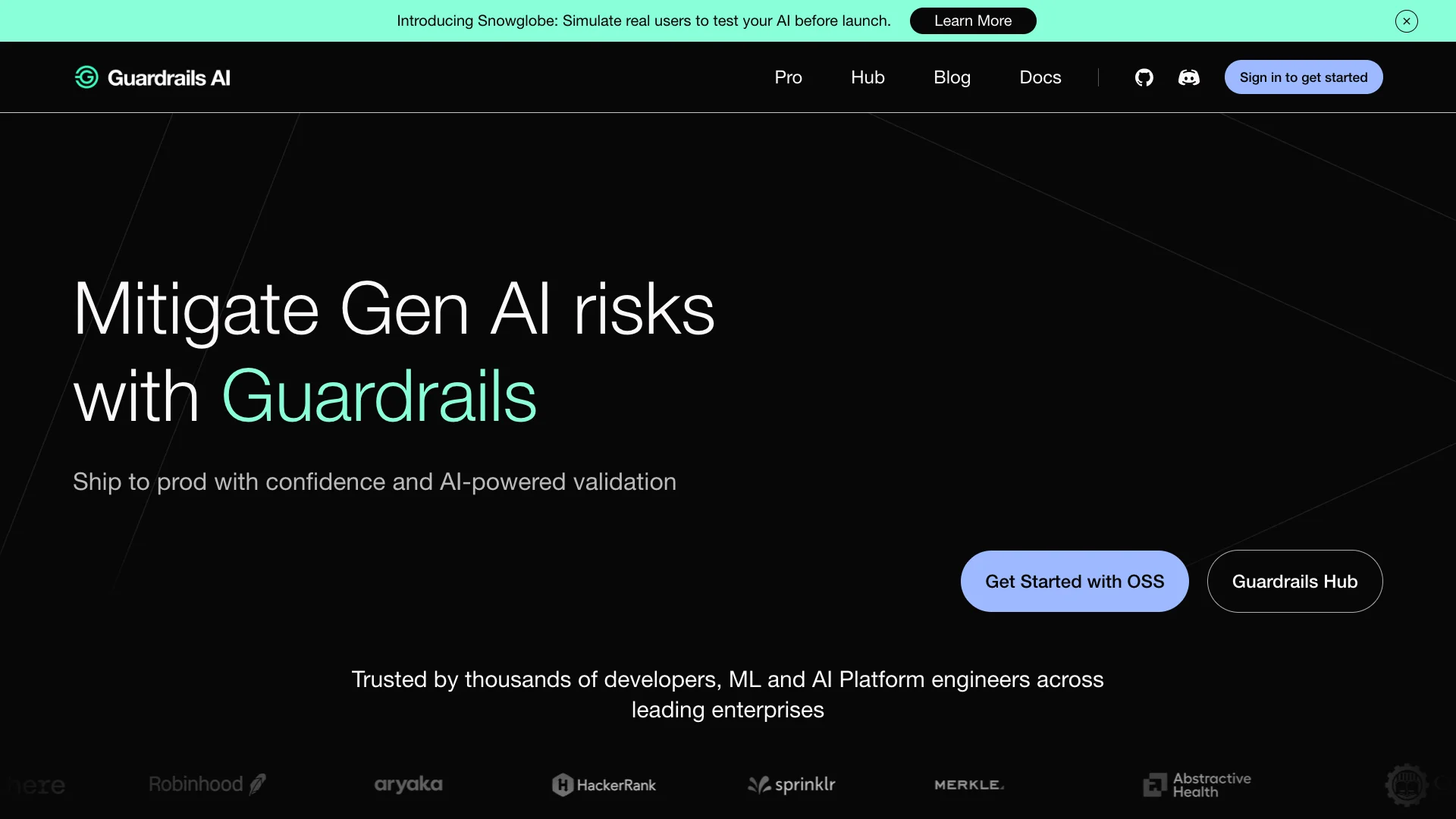
Guardrails AI is an AI reliability platform and framework for building, governing, and running production generative-AI applications. Official pages describe applying guardrails across models and deployment environments so teams can validate and control LLM behavior as those applications scale. Engineering and platform teams use it as a control layer around model outputs rather than as a legal or compliance research tool. It is runtime and reliability infrastructure for AI systems. Guardrails AI belongs with agentic foundations, alongside other evaluation, gateway, and runtime-control tools.
Agent Capabilities
- Real-time toxic language and hate speech detection with customizable thresholds
- Tone and style compliance enforcement for brand-consistent communications
- Competitor mention prevention to protect proprietary positioning and messaging
- Financial advice restriction to ensure regulatory compliance in fintech and advisory contexts
- Real-time hallucination detection using source-of-truth validation and semantic similarity
- Sensitive data leak prevention via PII redaction and pattern-based blocking
- Enterprise AI gateway safeguards with centralized policy management and audit logging
- LLM drop-in compatibility supporting OpenAI, Anthropic, Cohere, and open-source models
Primary Workflows & Use Cases
- Automated outbound sales sequences: validate every AI-generated email for tone, competitor mentions, and factual claims before sending
- Cross-border e-commerce product catalogs: ensure localized descriptions are culturally appropriate and free of restricted financial or medical claims
- Customer care triage: detect and block toxic language in real-time while verifying that responses align with internal knowledge bases
- Software engineering pipelines: prevent hallucinated API references and enforce coding standard compliance in AI-generated code reviews
- Performance creative testing: automatically filter ad copy that violates brand safety guidelines or includes unsubstantiated performance metrics
Similar Agentic Foundations & Multi-Agent Orchestration Agents
Explore alternatives and related autonomous systems in this category.
 MetaGPT
Different GPT roles form a software-company-style team that takes a one-line requirement and works through plans, documents, and code. The public docs at docs.deepwisdom.ai present MetaGPT as a multi-agent framework for assigning those roles and orchestrating the collaboration. It is tooling for people experimenting with LLM agents in a role-based setup, not a hosted app builder you log into.
 xpander.ai
 is an enterprise platform for running and governing AI agents and coding tools in an organization’s own environment. Official pages describe an AI gateway, an MCP gateway, an agent runtime, and a workspace, including support for running popular coding agents in the customer’s cloud under one policy. Teams keep the tools they already use while IT keeps a single place for access, routing, and policy. That combination of gateway and runtime is agent infrastructure, not a generic digital-workforce product. xpander.ai belongs with agentic foundations.
 TinyFish
 is web infrastructure for AI agents that need to search, extract, browse, and act on live websites. Official pages describe an enterprise, serverless platform for navigating sites, authenticating, extracting data, and automating web workflows, including monitoring pages for changes. Developers use it as the web stack behind their agents rather than as a human operations console. TinyFish is a runtime and data layer for agents and belongs with agentic foundations. Official examples include monitoring live pages for price or content changes and then alerting an agent or team.
KaibanJS is a JavaScript framework for building multi-agent systems. Official materials describe managing agents with a Kanban-style board so developers can see and organize multi-agent runs in a way that feels familiar if they have used tools such as Trello or Jira. You define agents and their work in code, then watch those runs move across the board as they proceed. It is a programming library and visual board for agent orchestration in JavaScript applications, not a business-operations or digital-workforce product. KaibanJS belongs with agentic foundations, where other agent frameworks and orchestration tools are listed.
Community & Channels
Are you the author of Guardrails AI? Claim your official badge.