
About This Agent
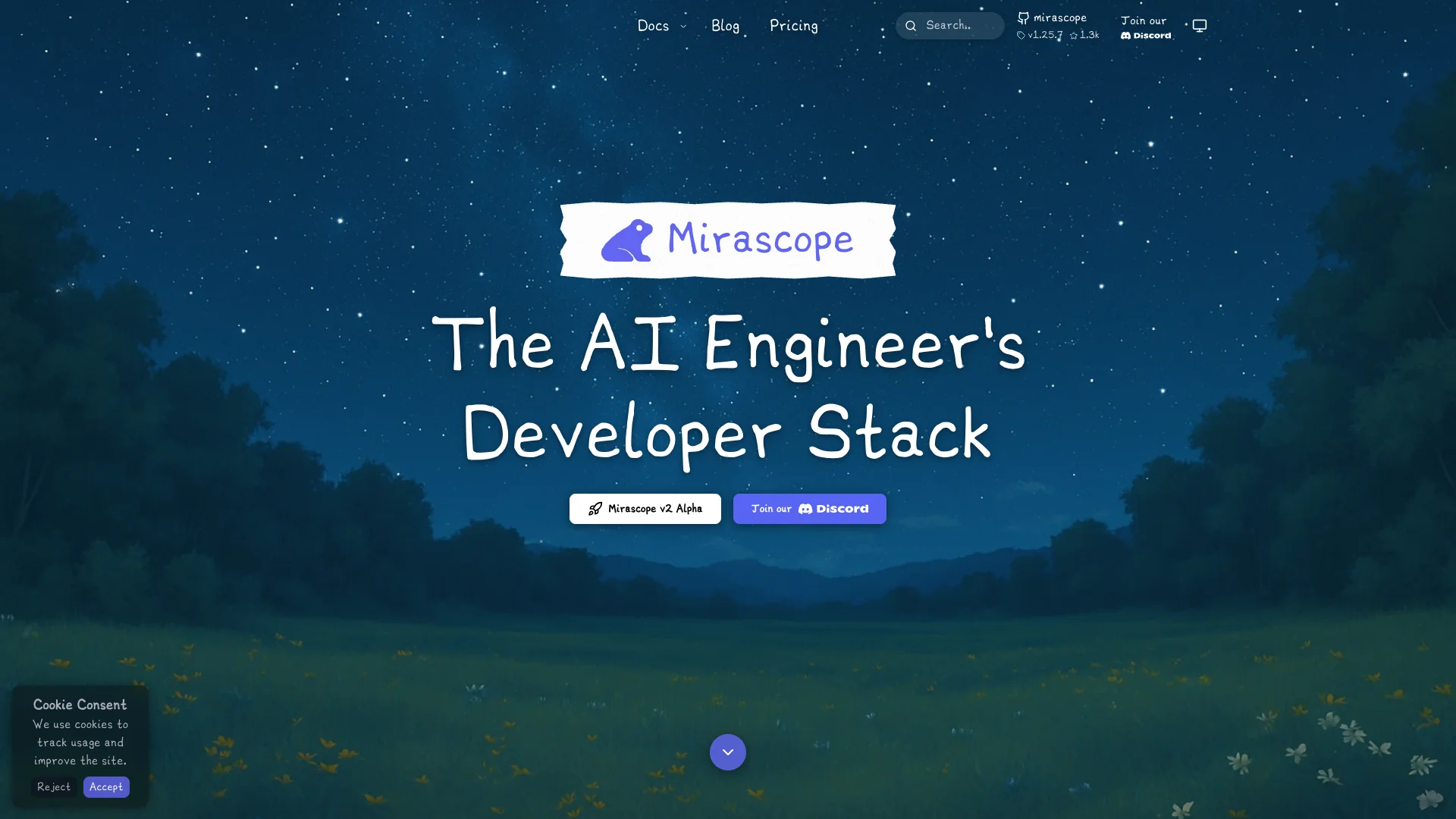
Mirascope is a Python toolkit for AI engineers who build, observe, and iterate on LLM applications. Official materials describe a library for typed model calls, tools, and operational features such as versioning, tracing, and cost tracking, so developers can ship LLM functions and agents in code rather than from a hosted operations console. It is meant to stay in the software-development workflow, from a first call through later observation. Mirascope is a developer framework, not a digital-workforce or business-process product, and belongs with agentic foundations.
Agent Capabilities
- Multi-provider LLM support with a unified API for OpenAI, Anthropic, Gemini, and more, enabling seamless model swapping without code changes.
- Pydantic-based structured output generation that validates and coerces LLM responses into type-safe Python objects, eliminating manual parsing.
- Decorator-based LLM calls that transform simple functions into robust AI operations with automatic retries, error handling, and logging.
- Automatic LLM call tracing that captures full request-response cycles, including latency and token usage, for deep debugging and performance analysis.
- Built-in versioning and cost tracking that records every model iteration and associated spend, facilitating budget control and auditability.
- Conversation logging that persists multi-turn interactions, enabling context restoration, compliance, and post-hoc analysis.
- Support for streaming responses and asynchronous execution, ensuring low-latency performance for real-time applications.
- Extensible middleware and callback hooks that allow custom logic for caching, rate limiting, and custom observability.
Primary Workflows & Use Cases
- Generate and validate multilingual product descriptions for cross-border e-commerce catalogs, ensuring schema compliance and localized tone.
- Automate performance creative testing by generating ad copy variations and scoring them against brand guidelines and engagement metrics.
- Deploy automated outbound sales agents that maintain conversation state, log interactions, and track costs per lead.
- Build customer care triage systems that classify inquiries, extract intent, and route tickets with structured outputs for downstream workflows.
- Accelerate software engineering pipelines by generating code documentation, unit tests, and code reviews with traceable and versioned LLM calls.
Similar Agentic Foundations & Multi-Agent Orchestration Agents
Explore alternatives and related autonomous systems in this category.
 MetaGPT
Different GPT roles form a software-company-style team that takes a one-line requirement and works through plans, documents, and code. The public docs at docs.deepwisdom.ai present MetaGPT as a multi-agent framework for assigning those roles and orchestrating the collaboration. It is tooling for people experimenting with LLM agents in a role-based setup, not a hosted app builder you log into.
 xpander.ai
 is an enterprise platform for running and governing AI agents and coding tools in an organization’s own environment. Official pages describe an AI gateway, an MCP gateway, an agent runtime, and a workspace, including support for running popular coding agents in the customer’s cloud under one policy. Teams keep the tools they already use while IT keeps a single place for access, routing, and policy. That combination of gateway and runtime is agent infrastructure, not a generic digital-workforce product. xpander.ai belongs with agentic foundations.
 TinyFish
 is web infrastructure for AI agents that need to search, extract, browse, and act on live websites. Official pages describe an enterprise, serverless platform for navigating sites, authenticating, extracting data, and automating web workflows, including monitoring pages for changes. Developers use it as the web stack behind their agents rather than as a human operations console. TinyFish is a runtime and data layer for agents and belongs with agentic foundations. Official examples include monitoring live pages for price or content changes and then alerting an agent or team.
KaibanJS is a JavaScript framework for building multi-agent systems. Official materials describe managing agents with a Kanban-style board so developers can see and organize multi-agent runs in a way that feels familiar if they have used tools such as Trello or Jira. You define agents and their work in code, then watch those runs move across the board as they proceed. It is a programming library and visual board for agent orchestration in JavaScript applications, not a business-operations or digital-workforce product. KaibanJS belongs with agentic foundations, where other agent frameworks and orchestration tools are listed.
Community & Channels
Are you the author of Mirascope? Claim your official badge.