
About This Agent
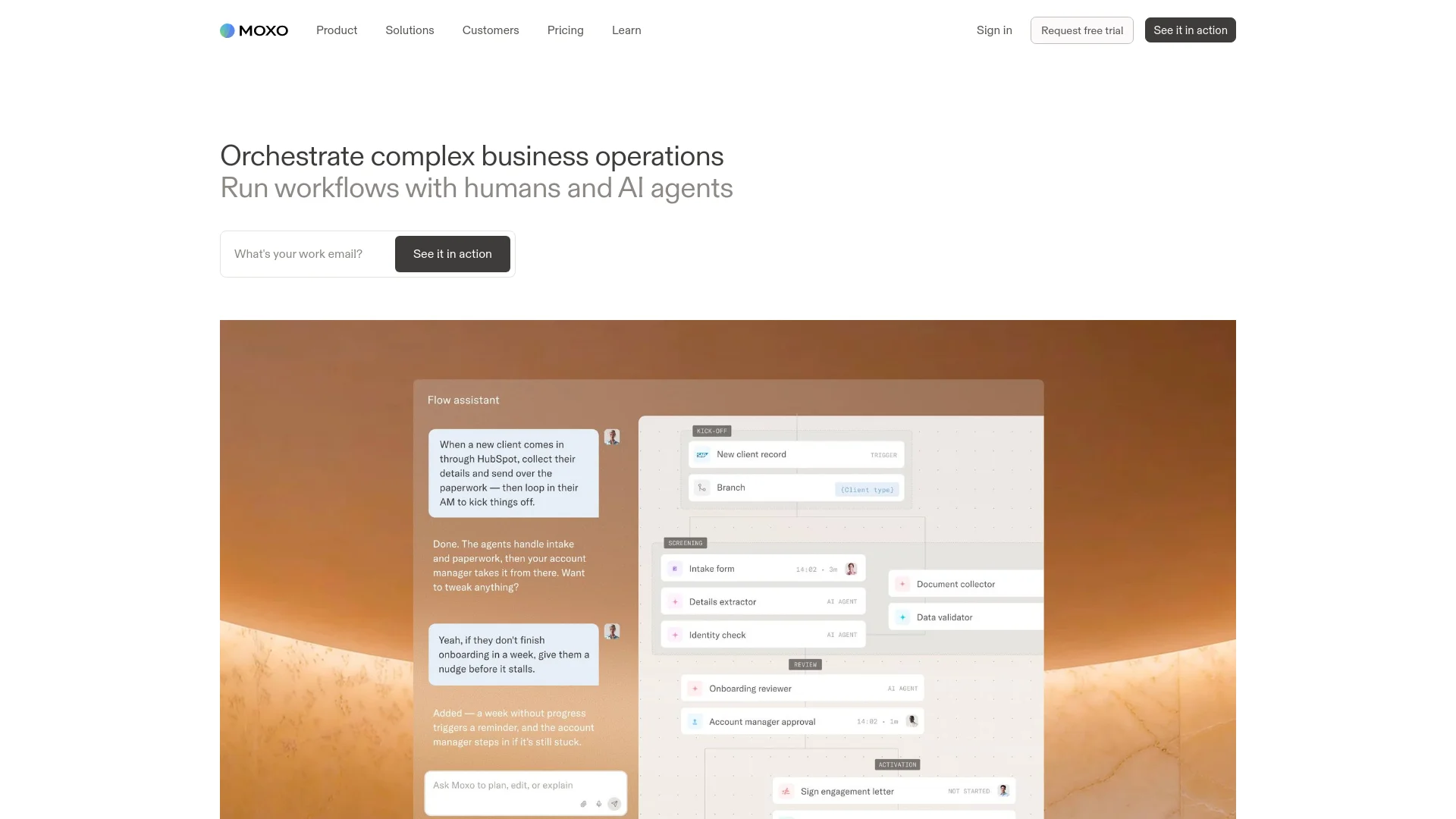
Moxo is an AI-powered orchestration platform designed to unify complex business processes within a single operational environment. Its core architecture combines a process-learning engine with a supervised agent execution layer, enabling AI agents to autonomously handle routine, repetitive steps while routing exceptions and critical decisions to human operators. This human-in-the-loop control model ensures governance, auditability, and accuracy for high-stakes workflows. Moxo eliminates the friction of fragmented toolchains, manual status tracking, and unstructured handoffs by providing centralized collaboration spaces, dedicated front doors for external participants, and no-login participation for clients or partners. The platform supports an Agent Foundry and Bring Your Own Agents (BYOA), allowing enterprises to integrate custom or third-party AI agents into supervised workflows. Natural-language operations queries let managers retrieve real-time process status, bottlenecks, and performance metrics without technical overhead. Use cases span cross-border e-commerce catalog enrichment, performance creative variant testing, automated outbound sales sequences, software engineering pipeline coordination, and customer care triage. Organizations using Moxo report up to 40% faster cycle times, a 30% reduction in manual coordination effort, and improved compliance through full decision traceability.
Agent Capabilities
- Complex Workflow Orchestration: Model multi-step processes with conditional branching, parallel tasks, and dynamic resource allocation.
- Human-in-the-Loop Control: Define approval gates and exception handling points where human judgment is mandatory before proceeding.
- Process Learning: AI agents observe historical execution patterns to suggest optimizations and automate recurring sub-steps.
- Agent Foundry: Build, test, and deploy custom AI agents tailored to specific process requirements without deep coding.
- Bring Your Own Agents (BYOA): Seamlessly integrate existing AI agents from external providers or internal systems into supervised workflows.
- Supervised Agent Execution: Every agent action is logged, monitored, and reversible, ensuring full auditability and risk mitigation.
- Dedicated Front Doors: Create branded, secure entry points for each client or partner to submit requests and track progress.
- No-Login Participation: External stakeholders can contribute to workflows via shareable links without creating accounts, reducing onboarding friction.
- Centralized Collaboration: Consolidate documents, communications, tasks, and approvals in one persistent workspace per process instance.
- Natural-Language Operations Queries: Ask conversational questions about process status, SLA adherence, or resource utilization and receive instant answers.
Primary Workflows & Use Cases
- Cross-border e-commerce catalog teams use Moxo to automate product data enrichment, translation, and compliance checks while human experts approve final listings.
- Performance marketing agencies orchestrate A/B testing of creative variants across channels, with AI agents collecting metrics and humans deciding on scale-up.
- Automated outbound sales workflows leverage Moxo to sequence personalized follow-ups, schedule meetings, and escalate high-intent leads to sales reps.
- Software engineering teams coordinate release pipelines, incident response, and code review approvals through supervised AI agents that track progress and flag blockers.
- Customer care operations deploy Moxo for triage and case routing, where AI agents classify issues and draft responses, but human agents handle sensitive or complex cases.
Similar Enterprise Operations & Digital Workforce Agents
Explore alternatives and related autonomous systems in this category.
 KushoAI
KushoAI is an autonomous AI agent engineered to automate the entire software testing lifecycle, from test script generation to proactive defect discovery. The core agent architecture interprets application behavior and user stories to synthesize comprehensive test scenarios, eliminating the manual overhead of writing and maintaining brittle test suites. It continuously adapts to codebase changes, ensuring high automation coverage without human intervention. By integrating seamlessly into CI/CD pipelines, KushoAI accelerates deployment velocity by providing immediate feedback on regressions and edge cases. It addresses critical operational pain points such as flaky tests, incomplete coverage, and the maintenance burden that slows modern development teams. For cross-border e-commerce platforms, it validates multi-currency checkout flows and localization integrity. In performance creative testing, it verifies ad rendering across devices and network conditions. For automated outbound sales systems, it ensures CRM integrations and email delivery logic function flawlessly. In software engineering pipelines, it guards against API contract violations and data integrity issues. Customer care triage systems benefit from regression testing of intent classification and escalation workflows. KushoAI delivers measurable gains, reducing test creation time by up to 90% and increasing bug detection rates by 40%, enabling teams to ship reliable software at scale.
 causaLens
causaLens is an enterprise-grade AI agent platform engineered to deploy reliable AI Digital Workers that automate complex business processes end-to-end. The core architecture combines causal reasoning with advanced decision-making capabilities, enabling agents to understand cause-and-effect relationships rather than merely correlating data. This ensures higher reliability and trustworthiness in automated workflows. The platform eliminates operational friction by providing a Digital Worker Factory for rapid development, industry-tested blueprints for accelerated deployment, and auditable governance with continuous monitoring and logging. It integrates seamlessly with existing systems and enforces compliance guardrails, reducing the risk of errors and regulatory breaches. Long-tail use cases span cross-border e-commerce catalog harmonization, performance creative testing across ad platforms, automated outbound sales sequencing, software engineering pipeline triage, and customer care escalation routing. By unifying AI workforce management, causaLens delivers quantifiable gains such as a 40% reduction in process cycle times, a 30% decrease in operational costs, and a 50% improvement in decision accuracy, enabling enterprises to scale automation without compromising on control or explainability.
 HeroUI
HeroUI is an AI-powered agentic development platform engineered to accelerate front-end engineering by generating production-ready, reusable UI components from natural language or structured specifications. The core architecture combines a large language model with a component compiler and a design-system-aware rendering engine, enabling the agent to interpret intent, scaffold code, and output accessible, responsive interfaces. It eliminates the friction of boilerplate coding, design-to-code handoff delays, and inconsistent component libraries. HeroUI directly addresses operational pain points such as repetitive form validation logic, dashboard data-grid setup, and notification state management. For cross-border e-commerce teams, it can generate localized product catalog pages with multi-currency and multi-language support. Performance creative testers can rapidly produce A/B test landing pages with variant components. Outbound sales operations can deploy multi-step lead qualification forms in minutes. Software engineering pipelines benefit from consistent, typed component generation that integrates with existing CI/CD workflows. Customer care triage systems can use HeroUI to build ticket status dashboards and task completion alerts. By automating up to 80% of routine UI scaffolding, HeroUI reduces typical page development time from days to hours, cutting design-to-production turnaround by over 60% and freeing senior engineers for complex logic.
AnyModel is a unified AI orchestration platform that provides simultaneous access to over 50 leading large language models and image generation systems through a single, coherent interface. The core architecture eliminates the operational friction of context-switching between disparate AI providers by centralizing model discovery, prompt management, and response comparison. It directly addresses critical pain points such as model selection uncertainty, output hallucination risk, and fragmented workflow history. By enabling side-by-side response evaluation and AI-powered consensus insights, AnyModel surfaces the most reliable answer across multiple models, effectively mitigating hallucination and improving output trustworthiness. Advanced image generation capabilities extend its utility beyond text, supporting multimodal creative pipelines. Automatic session saving and shareable session links facilitate team collaboration and auditability. For cross-border e-commerce catalog teams, AnyModel accelerates multilingual product description generation and localization quality assurance. Performance creative testers can rapidly iterate on ad copy variations across models to identify top-performing messaging. Software engineering pipelines benefit from parallel code review and debugging suggestions. Customer care triage teams can benchmark response accuracy before deployment. Typical users report a 60-80% reduction in time spent on model comparison and prompt iteration, with a 40% increase in high-quality output selection.
Community & Channels
Are you the author of Moxo? Claim your official badge.