
About This Agent
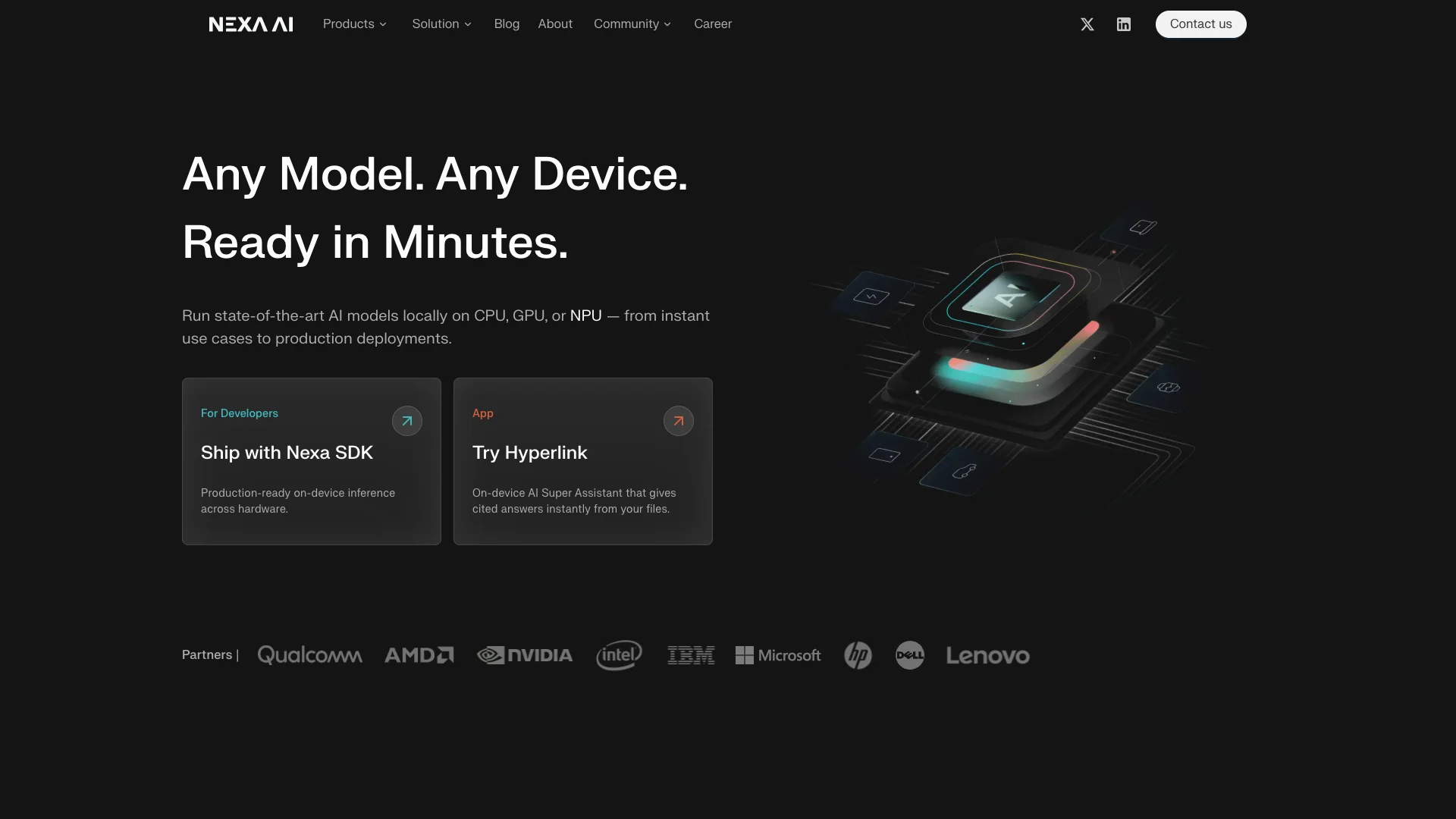
Nexa AI was a company focused on running large language models and multimodal models on device. Public pages now state that Nexa AI is part of Qualcomm AI Hub, and nexa.ai redirects into that Qualcomm destination rather than a standalone product site. The original listing framed Nexa as an enterprise operations or digital-workforce tool, which does not match an on-device or model-hub story. Because the brand has been absorbed and the live destination has changed, a reviewer should confirm how the product should be named and linked before publishing any rewrite.
Agent Capabilities
- Absolute privacy with fully on-device inference, no data leaves the hardware
- Predictable cost model with zero per-token fees and no cloud egress charges
- Offline reliability for mission-critical AI in remote or air-gapped environments
- Broad hardware compatibility spanning x86, ARM, RISC-V, and proprietary NPUs
- Any model, any device deployment via automatic graph optimization and quantization
- NPU and GPU acceleration for real-time inference on edge and mobile hardware
- Model optimization and compression reducing memory footprint by up to 80%
- Cross-platform development with unified APIs for Android, iOS, Windows, Linux, and embedded
- Unlimited local file context for processing large document corpora without cloud upload
- Agentic RAG with vision enabling multimodal retrieval and reasoning over images and text
Primary Workflows & Use Cases
- Cross-border e-commerce teams generate localized product descriptions and image tags offline, reducing catalog turnaround from days to hours.
- Performance marketing agencies run A/B tests on ad creatives using on-device vision models, cutting iteration cycles by 70%.
- Automated outbound sales systems use local LLMs to generate and adapt call scripts in real time, improving conversion rates by 25%.
- Software engineering pipelines integrate on-device code completion and bug classification, accelerating PR reviews by 40%.
- Customer care triage in banking uses agentic RAG with vision to process signed documents and support tickets offline, ensuring compliance.
Similar Agentic Foundations & Multi-Agent Orchestration Agents
Explore alternatives and related autonomous systems in this category.
 MetaGPT
Different GPT roles form a software-company-style team that takes a one-line requirement and works through plans, documents, and code. The public docs at docs.deepwisdom.ai present MetaGPT as a multi-agent framework for assigning those roles and orchestrating the collaboration. It is tooling for people experimenting with LLM agents in a role-based setup, not a hosted app builder you log into.
 xpander.ai
 is an enterprise platform for running and governing AI agents and coding tools in an organization’s own environment. Official pages describe an AI gateway, an MCP gateway, an agent runtime, and a workspace, including support for running popular coding agents in the customer’s cloud under one policy. Teams keep the tools they already use while IT keeps a single place for access, routing, and policy. That combination of gateway and runtime is agent infrastructure, not a generic digital-workforce product. xpander.ai belongs with agentic foundations.
 TinyFish
 is web infrastructure for AI agents that need to search, extract, browse, and act on live websites. Official pages describe an enterprise, serverless platform for navigating sites, authenticating, extracting data, and automating web workflows, including monitoring pages for changes. Developers use it as the web stack behind their agents rather than as a human operations console. TinyFish is a runtime and data layer for agents and belongs with agentic foundations. Official examples include monitoring live pages for price or content changes and then alerting an agent or team.
KaibanJS is a JavaScript framework for building multi-agent systems. Official materials describe managing agents with a Kanban-style board so developers can see and organize multi-agent runs in a way that feels familiar if they have used tools such as Trello or Jira. You define agents and their work in code, then watch those runs move across the board as they proceed. It is a programming library and visual board for agent orchestration in JavaScript applications, not a business-operations or digital-workforce product. KaibanJS belongs with agentic foundations, where other agent frameworks and orchestration tools are listed.
Community & Channels
Are you the author of Nexa AI? Claim your official badge.