
About This Agent
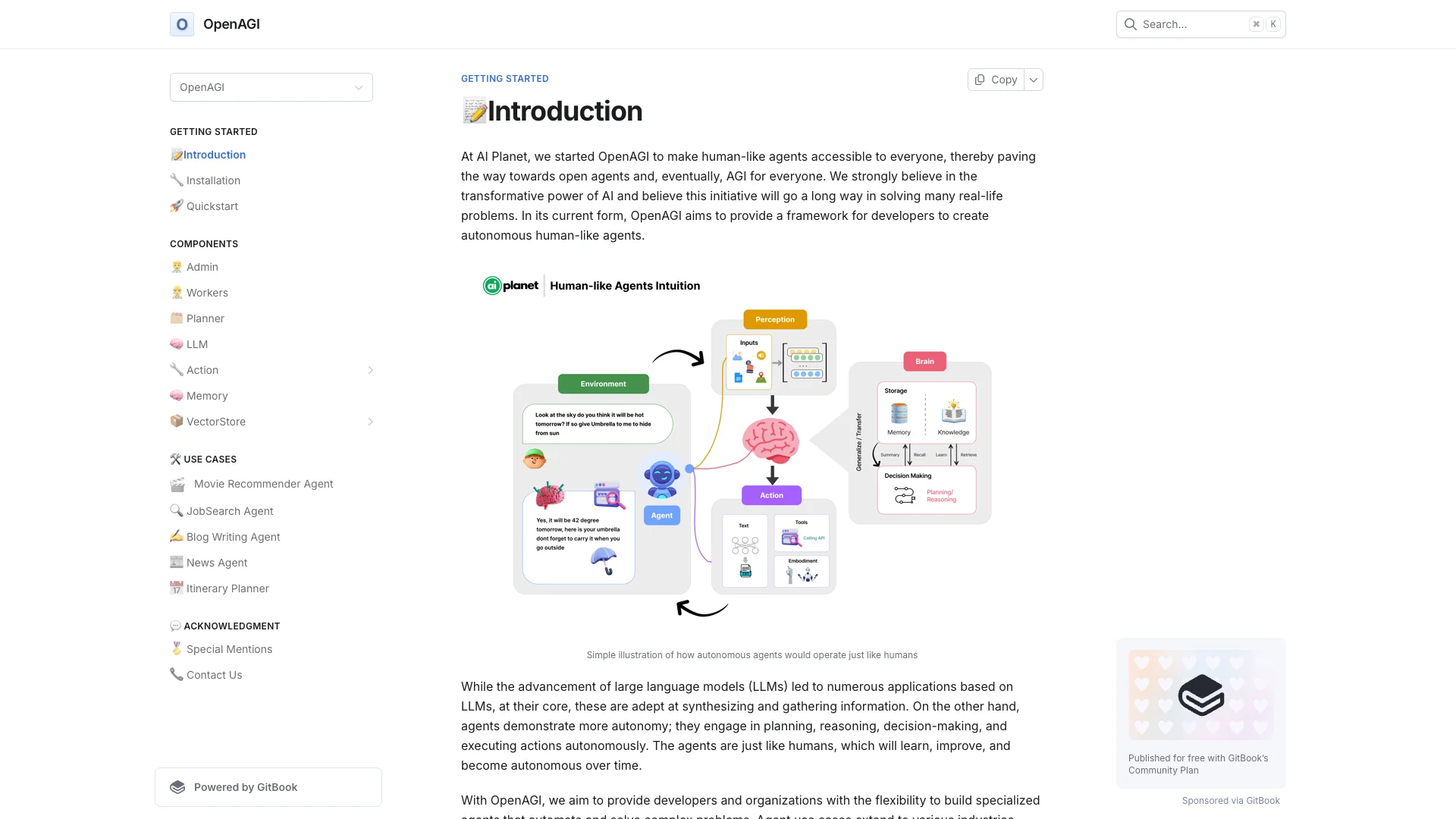
OpenAGI is an open-source project from AI Planet for building human-like agents that others can inspect and reuse. Official documentation describes components such as workers, a planner, memory, tools, and a vector store, with example agents for tasks such as writing, news, job search, and itineraries. Developers use those pieces to compose their own agents rather than buying a hosted operations suite. OpenAGI is a framework for composing agents and belongs with agentic foundations and multi-agent orchestration. The project’s stated aim is to make these agent building blocks more accessible, not to sell a closed operations suite.
Agent Capabilities
- Flexible agent architecture supporting both automated and manual configuration for diverse deployment scenarios
- Automated configuration generation reduces setup time from days to minutes
- Autonomous planning and execution with goal-oriented autonomy for end-to-end task completion
- Continuous learning and adaptation through real-time feedback loops and reflection-based learning
- Complex decision-making capabilities using multi-step reasoning and contextual awareness
- Specialized agent tuning for domain-specific optimization without retraining the core model
- Streamlined integration with existing APIs, databases, and third-party tools via standardized connectors
- Reflection-based learning that analyzes past actions to improve future performance and reduce errors
Primary Workflows & Use Cases
- Automate cross-border e-commerce catalog updates, including price adjustments and localization, across multiple marketplaces
- Run high-volume performance creative testing by generating, deploying, and analyzing ad variants in real time
- Power automated outbound sales sequences with personalized messaging and intelligent follow-up scheduling
- Streamline software engineering pipelines by triaging bugs, reviewing code, and generating pull request summaries
- Enhance customer care triage by classifying inquiries, suggesting resolutions, and escalating complex cases to human agents
Similar Agentic Foundations & Multi-Agent Orchestration Agents
Explore alternatives and related autonomous systems in this category.
 MetaGPT
Different GPT roles form a software-company-style team that takes a one-line requirement and works through plans, documents, and code. The public docs at docs.deepwisdom.ai present MetaGPT as a multi-agent framework for assigning those roles and orchestrating the collaboration. It is tooling for people experimenting with LLM agents in a role-based setup, not a hosted app builder you log into.
 xpander.ai
 is an enterprise platform for running and governing AI agents and coding tools in an organization’s own environment. Official pages describe an AI gateway, an MCP gateway, an agent runtime, and a workspace, including support for running popular coding agents in the customer’s cloud under one policy. Teams keep the tools they already use while IT keeps a single place for access, routing, and policy. That combination of gateway and runtime is agent infrastructure, not a generic digital-workforce product. xpander.ai belongs with agentic foundations.
 TinyFish
 is web infrastructure for AI agents that need to search, extract, browse, and act on live websites. Official pages describe an enterprise, serverless platform for navigating sites, authenticating, extracting data, and automating web workflows, including monitoring pages for changes. Developers use it as the web stack behind their agents rather than as a human operations console. TinyFish is a runtime and data layer for agents and belongs with agentic foundations. Official examples include monitoring live pages for price or content changes and then alerting an agent or team.
KaibanJS is a JavaScript framework for building multi-agent systems. Official materials describe managing agents with a Kanban-style board so developers can see and organize multi-agent runs in a way that feels familiar if they have used tools such as Trello or Jira. You define agents and their work in code, then watch those runs move across the board as they proceed. It is a programming library and visual board for agent orchestration in JavaScript applications, not a business-operations or digital-workforce product. KaibanJS belongs with agentic foundations, where other agent frameworks and orchestration tools are listed.
Community & Channels
Are you the author of OpenAGI? Claim your official badge.