
OpenHuman
About This Agent
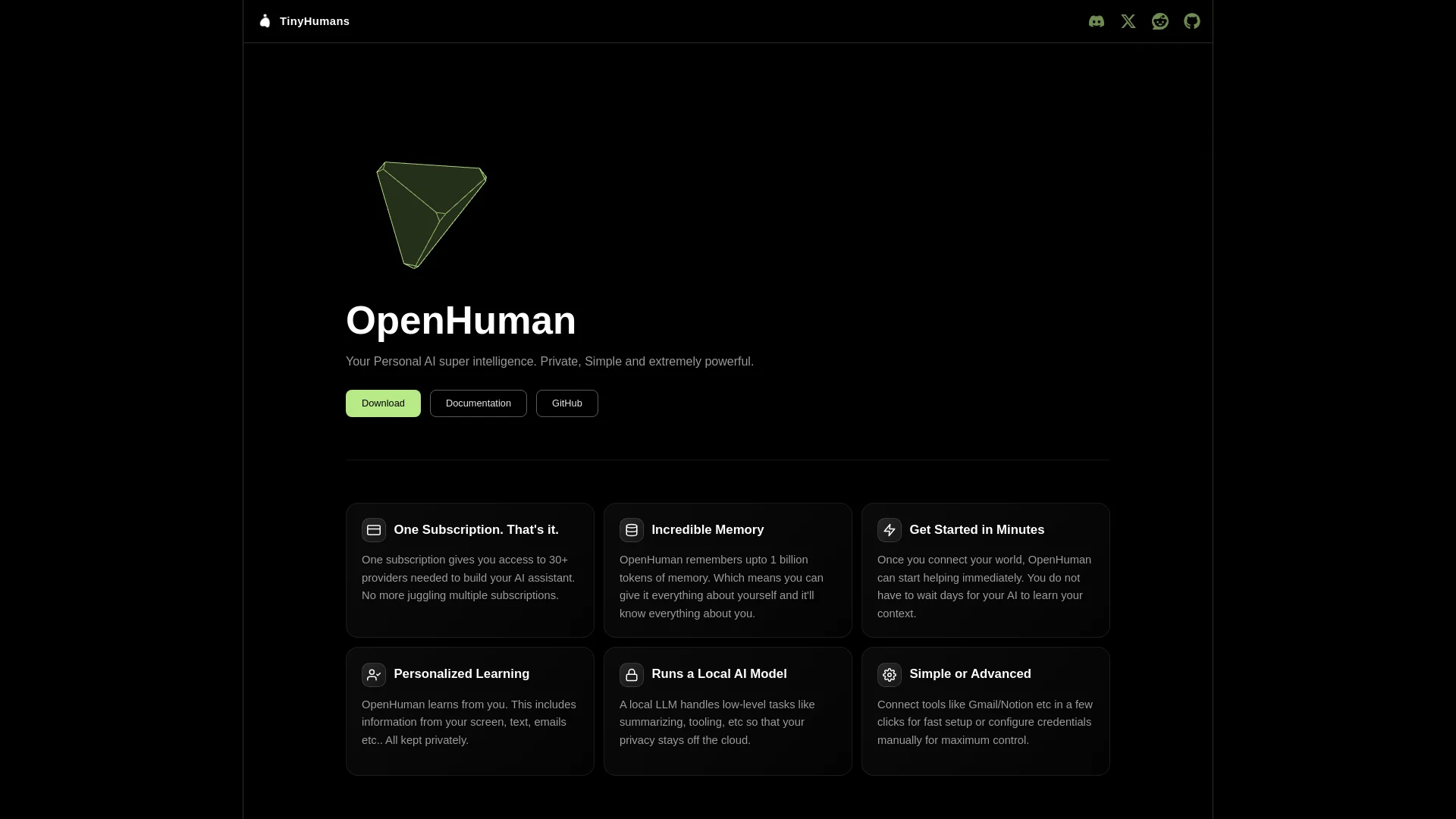
OpenHuman is a personal AI assistant engineered for privacy-preserving automation. Its core architecture integrates a local Large Language Model (LLM) with a proprietary instant context-learning engine, enabling the agent to ingest and index data from connected applications without transmitting sensitive information to external servers. The system features massive memory capacity, allowing it to retain and recall extensive historical interactions, documents, and project states, thereby eliminating the friction of repetitive context-setting and manual data retrieval. By learning individual work styles and preferences, OpenHuman proactively manages tasks, drafts communications, and prioritizes workflows. It operates under a unified subscription model, providing access to a broad tool ecosystem with custom configuration options for enterprise-specific integrations. This design addresses operational pain points such as data silos, context switching, and compliance overhead. Concrete use cases include automating cross-border e-commerce catalog enrichment, accelerating performance creative testing by generating ad variations, supporting automated outbound sales sequences with personalized outreach, streamlining software engineering pipelines through automated code review and documentation, and enhancing customer care triage with instant ticket summarization. Organizations can achieve up to 40% reduction in administrative task time and a 3x faster response rate in client-facing operations.
Agent Capabilities
- Local LLM processing ensures all data remains on-device or within a private infrastructure, eliminating third-party data exposure.
- Massive memory capacity enables long-term retention of user preferences, project history, and interaction patterns for continuous improvement.
- Instant context learning automatically indexes connected app data (email, calendars, CRMs) to provide relevant responses without manual setup.
- Personalized learning algorithms adapt to individual work styles, communication tone, and task prioritization over time.
- Unified subscription model consolidates access to multiple AI capabilities and tool integrations under a single cost structure.
- Tool ecosystem integration supports seamless connectivity with popular SaaS platforms, APIs, and custom enterprise systems.
- Custom configuration allows granular control over automation rules, data retention policies, and integration permissions.
- Proactive task management identifies action items from communications and schedules follow-ups, reducing oversight risk.
Primary Workflows & Use Cases
- Automate cross-border e-commerce catalog creation by generating localized product descriptions and SEO metadata from raw supplier data.
- Accelerate performance creative testing by producing multiple ad copy and visual variants for A/B testing across channels.
- Enhance automated outbound sales by drafting personalized email sequences based on prospect interaction history and intent signals.
- Streamline software engineering pipelines by auto-generating code comments, pull request summaries, and release notes from commit history.
- Optimize customer care triage by summarizing incoming tickets and suggesting resolution paths based on historical issue patterns.
Similar Data Intelligence & Autonomous BI Agents
Explore alternatives and related autonomous systems in this category.
 Hex
HexHex is an AI-native analytics platform that combines a governed semantic layer with autonomous AI agents to make enterprise data universally accessible and actionable. The core architecture integrates natural language query processing with purpose-built analysis agents that interpret user intent, map it to trusted business context, and execute complex analytical workflows across notebooks and visualizations. This design eliminates the friction of SQL dependency, inconsistent metric definitions, and ad-hoc data exploration, replacing them with a self-serve environment where both technical and non-technical users can pose questions in plain English and receive verifiable, context-aware answers. The platform enforces AI workspace rules and semantic model authoring to ensure every AI-generated output adheres to corporate data governance and access controls. For cross-border e-commerce operations, Hex enables real-time catalog performance analysis and localized pricing optimization. In performance marketing, teams use it to automate creative testing cohort analysis and media mix attribution. Software engineering organizations leverage Hex for CI/CD pipeline metric correlation and incident root-cause exploration. Customer care teams deploy it to triage support ticket trends and sentiment drivers. By reducing time-to-insight from days to minutes and enabling self-service for over 80% of routine analytical queries, Hex delivers a measurable 5-10x productivity gain in analytics workflows.
 LangGraph
LangGraph is a specialized orchestration framework for building stateful, controllable AI agents that execute complex, multi-step tasks with high reliability. It provides a low-level graph-based API that models agent workflows as explicit nodes and edges, enabling diverse control flows such as cycles, branching, and conditional transitions. This architecture directly addresses common operational pain points in production AI: unpredictable agent behavior, lack of observability, and difficulty enforcing quality standards. LangGraph eliminates these frictions through built-in moderation loops, human-in-the-loop checkpoints, and real-time streaming of agent actions, allowing teams to inspect and intervene at any step. It also includes persistent memory for context retention across sessions and a fault-tolerant design that gracefully handles errors and retries. Deployable across cloud, on-premise, or hybrid environments, LangGraph scales horizontally to support high-throughput workloads. Concrete business use cases include automating cross-border e-commerce catalog enrichment with multilingual validation, orchestrating performance creative A/B testing pipelines, managing automated outbound sales sequences with dynamic follow-ups, coordinating software engineering CI/CD tasks, and triaging customer care requests with escalation logic. By reducing manual oversight and rework, LangGraph can cut agent development time by up to 40% and improve task completion rates by 30%.
Rita AI is an autonomous job application agent that automates the entire job search lifecycle, from discovery to interview scheduling. The core architecture integrates automated job discovery engines with AI-powered matching algorithms that parse candidate profiles, preferences, and historical application success to identify optimal opportunities. It generates personalized application materials, including resumes and cover letters, tailored to each role's requirements, and submits them directly through applicant tracking systems. The agent operates through an email-driven interaction model, enabling asynchronous communication and preference learning over time. A user approval workflow ensures that candidates maintain control over final submissions, while customizable search parameters allow for fine-grained filtering by location, salary, seniority, and industry. Real-time status monitoring provides transparent tracking of application progress, and automated interview coordination handles scheduling logistics. Rita AI eliminates the repetitive friction of manual job searching, application tailoring, and follow-up communications. For staffing agencies, career transition services, and enterprise talent acquisition teams, it reduces time-to-application by up to 80% and increases application volume by 5x, while improving match quality through continuous learning. It also supports bulk application campaigns for recent graduates or workforce re-entry programs, delivering measurable productivity gains across high-volume recruitment scenarios.
Simplescraper is an AI-powered web scraping platform that converts any URL into a structured, machine-readable dataset through an automated recipe generation engine. The core agent architecture analyzes the target page's DOM, identifies repeating patterns, and generates a scraping recipe without requiring manual CSS selector configuration or scripting. This eliminates the friction of traditional scraping workflows, which demand extensive developer time for selector maintenance, anti-bot handling, and data normalization. By leveraging AI to interpret page structure, Simplescraper reduces setup time from hours to minutes and enables non-technical operators to extract data reliably. For cross-border e-commerce, it automates competitor price monitoring and product catalog aggregation across multiple regional sites. In performance creative testing, it scrapes ad libraries and social platforms to gather competitor copy and visual assets for benchmarking. For automated outbound sales, it enriches lead lists with firmographic and technographic data from company websites. In software engineering, it feeds live documentation and changelog data into internal knowledge bases. For customer care triage, it extracts FAQ and support article content to train chatbots. Users report a 90% reduction in scraping configuration effort and a 5x faster time-to-insight compared to manual methods.
Community & Channels
Are you the author of OpenHuman? Claim your official badge.