
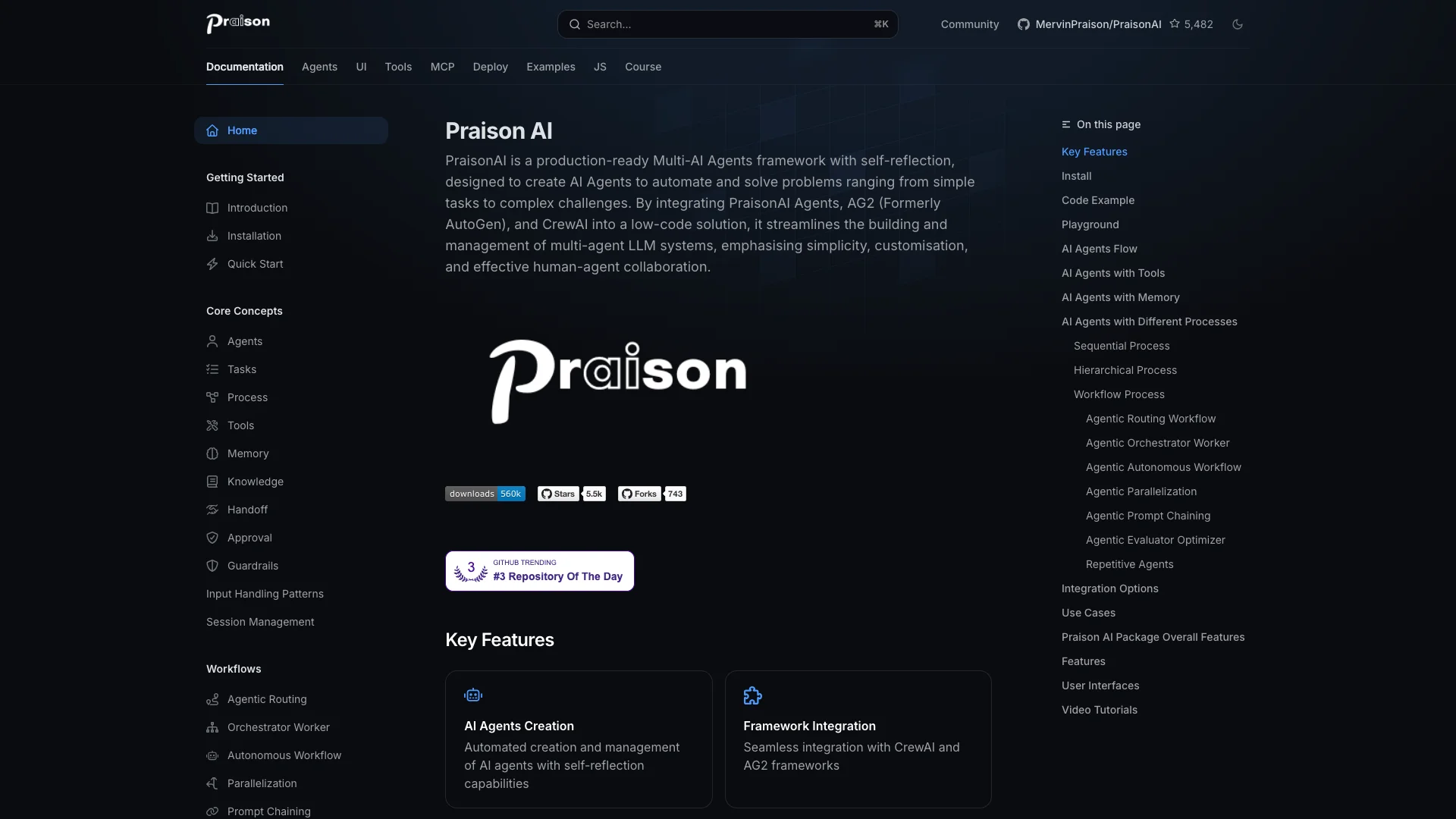
About This Agent
PraisonAI is a framework and toolkit for running AI agents on your own computers, including setups that can work fully offline so private data does not have to leave the building. Official documentation covers agents, teams, tools, memory, knowledge, and related command-line, SDK, and desktop options for building and deploying those agents. It is aimed at teams that want to develop and host agents themselves rather than only use a hosted operations console. PraisonAI is an agent framework, not a generic enterprise digital-workforce suite, and belongs with agentic foundations.
Agent Capabilities
- Agentic orchestration with dynamic task decomposition and routing across specialized agents
- Self-reflection and reasoning loops that enable agents to validate outputs and self-correct
- Multimodal agent support for processing text, images, audio, and structured data
- Parallel task execution to accelerate multi-step workflows and reduce latency
- Extensive LLM support including proprietary and open-source models for flexible deployment
- Seamless integration with popular AI frameworks such as LangChain, LlamaIndex, and AutoGen
- Autonomous workflow design with human-in-the-loop checkpoints for governance
- Scalable agent creation API for embedding intelligence into existing enterprise systems
Primary Workflows & Use Cases
- Automate cross-border e-commerce catalog generation with localized product descriptions, attributes, and SEO tags across multiple languages
- Run performance creative testing by generating ad variants, predicting engagement, and iterating based on real-time metrics
- Orchestrate automated outbound sales sequences that personalize outreach, follow-ups, and meeting scheduling based on prospect behavior
- Triage customer care tickets by classifying intent, extracting entities, and routing to appropriate resolution workflows or human agents
- Accelerate software engineering pipelines by automating code review, bug triage, and test case generation with self-reflecting agents
Similar Agentic Foundations & Multi-Agent Orchestration Agents
Explore alternatives and related autonomous systems in this category.
 MetaGPT
Different GPT roles form a software-company-style team that takes a one-line requirement and works through plans, documents, and code. The public docs at docs.deepwisdom.ai present MetaGPT as a multi-agent framework for assigning those roles and orchestrating the collaboration. It is tooling for people experimenting with LLM agents in a role-based setup, not a hosted app builder you log into.
 xpander.ai
 is an enterprise platform for running and governing AI agents and coding tools in an organization’s own environment. Official pages describe an AI gateway, an MCP gateway, an agent runtime, and a workspace, including support for running popular coding agents in the customer’s cloud under one policy. Teams keep the tools they already use while IT keeps a single place for access, routing, and policy. That combination of gateway and runtime is agent infrastructure, not a generic digital-workforce product. xpander.ai belongs with agentic foundations.
 TinyFish
 is web infrastructure for AI agents that need to search, extract, browse, and act on live websites. Official pages describe an enterprise, serverless platform for navigating sites, authenticating, extracting data, and automating web workflows, including monitoring pages for changes. Developers use it as the web stack behind their agents rather than as a human operations console. TinyFish is a runtime and data layer for agents and belongs with agentic foundations. Official examples include monitoring live pages for price or content changes and then alerting an agent or team.
KaibanJS is a JavaScript framework for building multi-agent systems. Official materials describe managing agents with a Kanban-style board so developers can see and organize multi-agent runs in a way that feels familiar if they have used tools such as Trello or Jira. You define agents and their work in code, then watch those runs move across the board as they proceed. It is a programming library and visual board for agent orchestration in JavaScript applications, not a business-operations or digital-workforce product. KaibanJS belongs with agentic foundations, where other agent frameworks and orchestration tools are listed.
Community & Channels
Are you the author of PraisonAI? Claim your official badge.