
Pydantic AI
About This Agent
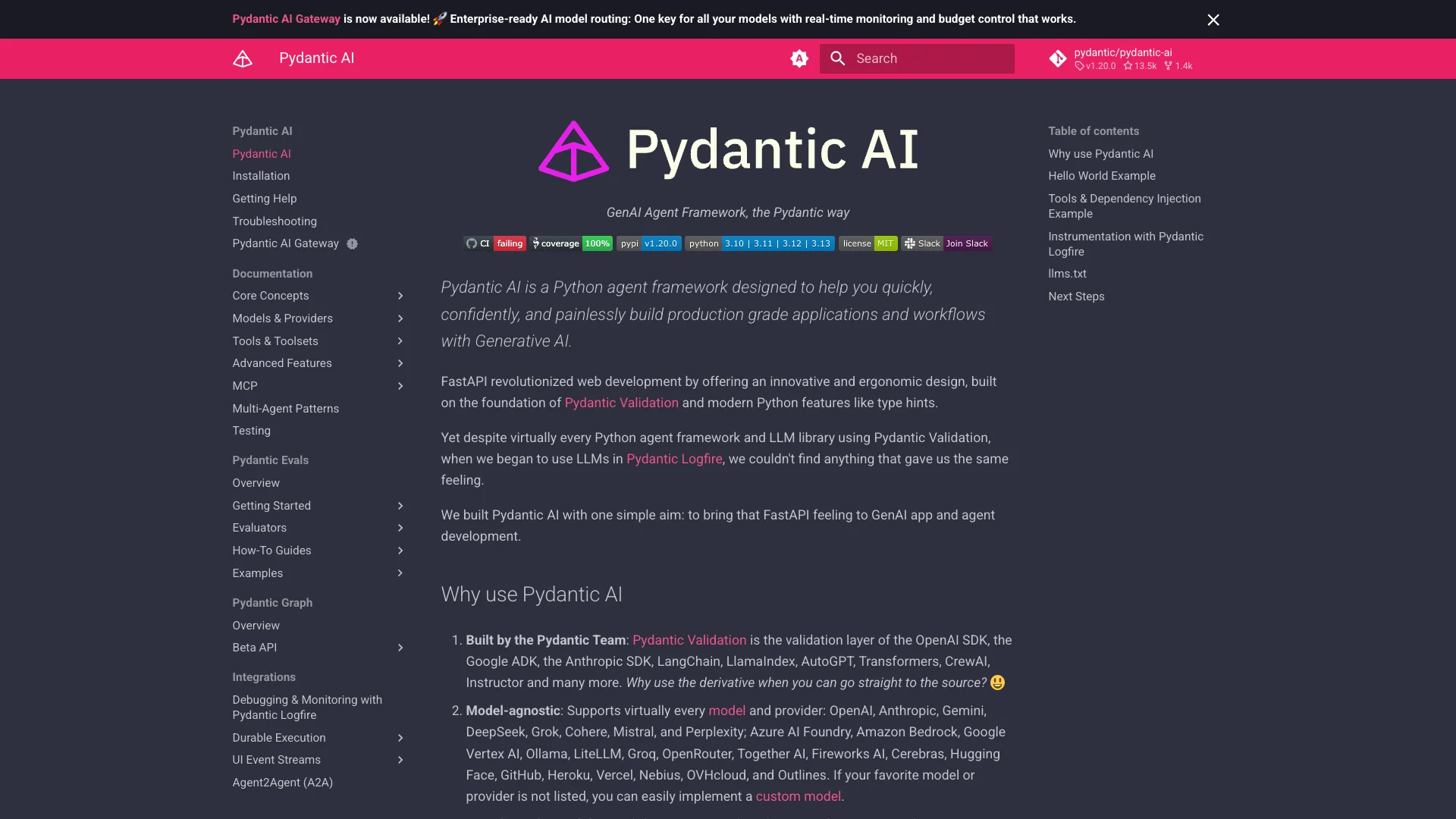
Pydantic AI is a Python agent framework designed for building production-grade GenAI applications with a focus on type safety and developer efficiency. At its core, it leverages Pydantic models to define agent behaviors, tools, and structured outputs, ensuring that every interaction is validated and type-checked at compile time. This eliminates common runtime errors and reduces debugging overhead, accelerating development cycles. The framework supports graph-based workflows for complex, multi-step processes, durable execution for fault tolerance, and human-in-the-loop approval gates for critical actions. It is model-agnostic, allowing seamless integration with various LLMs, and includes built-in observability via Logfire for monitoring and tracing. Pydantic AI addresses operational pain points such as unreliable outputs, lack of workflow control, and poor integration with existing systems. It enables concrete use cases like automated cross-border e-commerce catalog generation with consistent data schemas, performance creative testing with structured feedback loops, and customer care triage with escalation workflows. By reducing boilerplate code and enforcing type safety, teams can achieve up to 40% faster agent development and a 30% reduction in production incidents.
Agent Capabilities
- Pydantic-driven agent definition ensures type-safe, validated data structures for all inputs and outputs.
- Fully type-safe development environment catches errors at compile time, reducing runtime failures.
- Flexible tooling and instruction system allows dynamic agent behavior adaptation without code changes.
- Graph-based workflow support enables complex, branching logic for multi-step agent processes.
- Durable execution guarantees state persistence and recovery across failures, ensuring reliability.
- Human-in-the-loop approval mechanisms provide safe checkpoints for high-stakes actions.
- Inter-agent and UI integration capabilities facilitate collaborative multi-agent systems and frontend connectivity.
- Streamed structured outputs deliver real-time, validated data chunks for responsive applications.
- Model-agnostic LLM support allows switching between providers without altering agent logic.
- Integrated observability with Logfire offers detailed tracing and monitoring for performance tuning.
Primary Workflows & Use Cases
- Automate cross-border e-commerce product catalog generation with validated, localized descriptions and attributes.
- Orchestrate performance creative testing by generating ad variants and collecting structured feedback for rapid iteration.
- Power automated outbound sales pipelines with type-safe lead qualification and personalized outreach sequences.
- Streamline software engineering workflows by automating code review comments and PR summaries with structured outputs.
- Enhance customer care triage with intelligent routing and escalation workflows that require human approval for sensitive actions.
Similar Agentic Foundations & Multi-Agent Orchestration Agents
Explore alternatives and related autonomous systems in this category.
 Haystack
Haystack is an open-source AI framework engineered for building production-grade applications and agents. It provides a modular architecture for orchestrating complex agent workflows, enabling developers to design, deploy, and scale AI systems with precision. The framework eliminates the friction of integrating disparate AI components by offering a unified development and deployment environment that supports advanced Retrieval-Augmented Generation (RAG) pipelines, multimodal inputs, and extensive integrations across the AI stack. Haystack's visual pipeline editor and multi-pipeline experimentation capabilities streamline iterative development, reducing time-to-production for sophisticated AI solutions. It is built for enterprise scalability, with private support options for organizations requiring strict data governance. By abstracting infrastructure complexities, Haystack allows teams to focus on logic and outcomes, cutting development cycles by up to 40%. Use cases span cross-border e-commerce catalog enrichment, automated performance creative testing, outbound sales sequence optimization, software engineering code review automation, and customer care triage. Whether you are prototyping a proof-of-concept or deploying a mission-critical system, Haystack provides the control, transparency, and reliability required for high-stakes AI operations.
 Gumloop
Gumloop is a no-code AI agent platform that enables teams to design, deploy, and manage complex automation workflows through a visual drag-and-drop interface. The core architecture combines a powerful visual builder with event-driven execution and AI-enhanced decision making, allowing users to construct pipelines that integrate large language models, custom logic, and external data sources without writing code. The platform includes extensive AI nodes for tasks such as data analysis, intelligent categorization, and dynamic routing, which adapt workflow paths based on real-time inputs. With 115+ native integrations and support for custom database connectivity, Gumloop eliminates the friction of manual data orchestration and API glue code. It addresses operational pain points like repetitive data entry, slow document processing, and fragmented tool chains. Concrete use cases include automating cross-border e-commerce catalog enrichment, orchestrating performance creative testing across ad platforms, triggering personalized outbound sales sequences, streamlining software engineering ticket triage, and enhancing customer care with automated response routing. By reducing manual effort and enabling parallel processing, Gumloop delivers measurable productivity gains, often cutting workflow turnaround times by up to 80% and freeing teams to focus on higher-value strategic tasks.
 Flowise
Flowise is an open-source, low-code platform engineered for the visual orchestration of AI agents and chatbots. Its core architecture employs a drag-and-drop canvas that abstracts the complexity of LangChain and LangGraph, enabling developers and technical operators to design, prototype, and deploy agentic workflows without writing boilerplate glue code. The platform supports single-agent task automation and multi-agent orchestration, where specialized sub-agents collaborate under a supervisor to handle complex, sequential reasoning. Flowise eliminates the operational friction of managing prompt templates, vector database integrations, and model API switches by providing pre-built nodes and ready-to-use templates. It also incorporates human-in-the-loop checkpoints, allowing domain experts to approve or correct outputs before execution, which is critical for regulated industries. Deployable on-premises, in a private cloud, or via Kubernetes, Flowise scales from proof-of-concept to production with built-in monitoring and logging. Typical long-tail use cases include automating cross-border e-commerce catalog enrichment, generating and A/B testing performance creative variants, powering outbound sales qualification sequences, accelerating software engineering documentation pipelines, and triaging customer care tickets with sentiment analysis. Teams report up to 80% faster agent prototyping and a 60% reduction in integration development time compared to code-first frameworks.
 Kragent.ai
Kragent.ai is an autonomous AI agent platform engineered to manage complex, multi-stage workflows from initial concept through final delivery. Its core architecture integrates generative visualization, virtual world development, academic research and summarization, and software repository analysis into a unified reasoning and execution engine. The platform eliminates operational friction by automating deep research synthesis, codebase comprehension, and iterative content generation, reducing the need for manual oversight across disparate tools. For cross-border e-commerce teams, Kragent.ai generates localized product visuals and market-specific creative assets, accelerating catalog deployment. In performance marketing, it rapidly prototypes and tests ad variations against synthetic environments, shortening creative iteration cycles. Software engineering organizations leverage its repository analysis to generate architectural documentation, identify technical debt, and propose refactoring strategies. Academic and R&D departments use it to distill large corpora into structured literature reviews and research briefs. By integrating these capabilities, Kragent.ai delivers measurable productivity gains, including up to 70% reduction in research-to-report turnaround, 50% faster creative production, and a 40% decrease in code review preparation time, enabling teams to focus on strategic decision-making rather than repetitive execution.
Community & Channels
Are you the author of Pydantic AI? Claim your official badge.