About This Agent
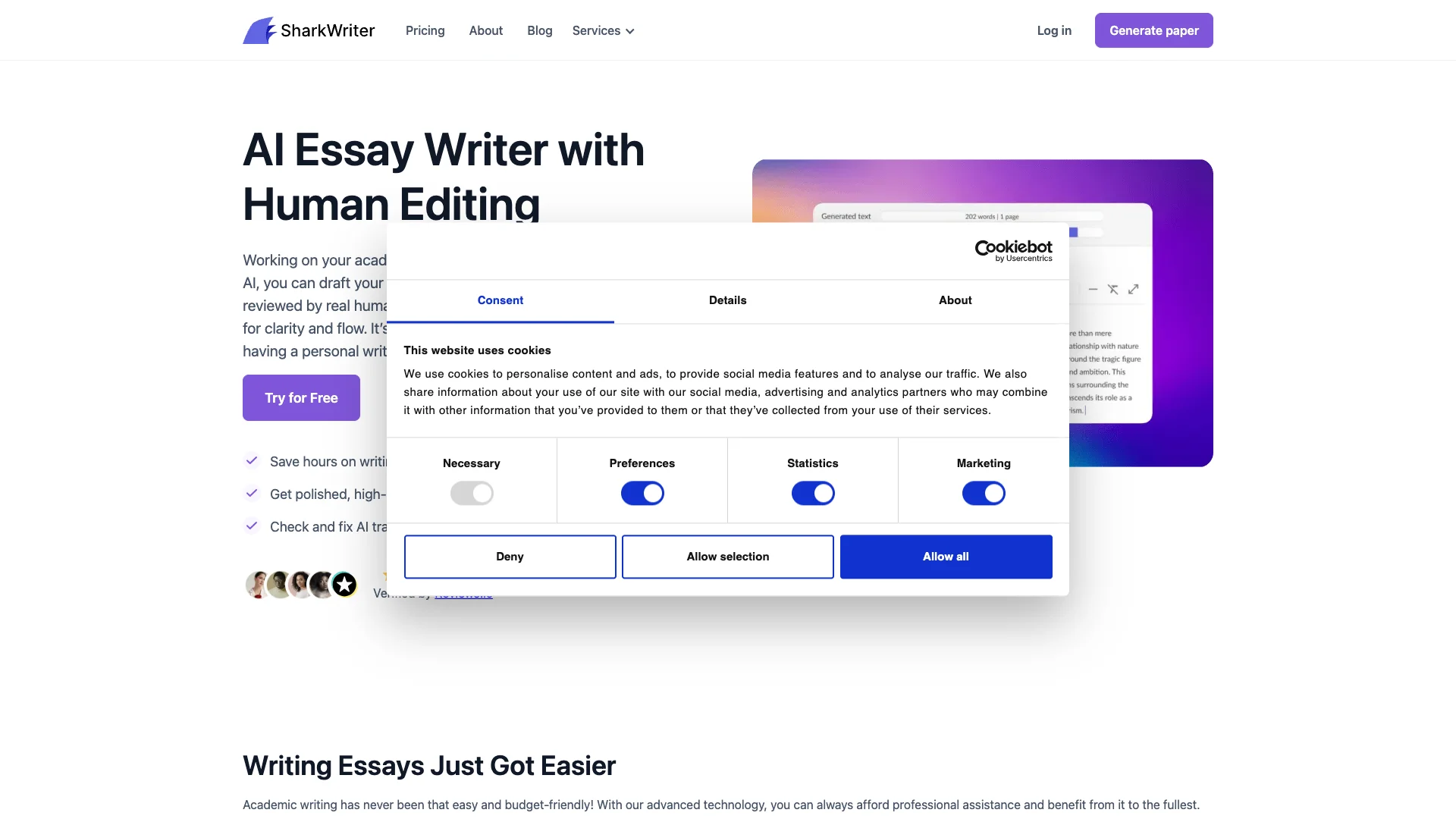
Sharkwriter is an AI-powered academic writing platform that combines large language model draft generation with expert human editing to produce high-quality, publication-ready papers. The core architecture supports multi-document ingestion, enabling the AI to synthesize information from multiple sources while adhering to academic standards and generating relevant citations. The system eliminates the friction of starting from a blank page, managing references, and ensuring stylistic consistency, which are common pain points for researchers, graduate students, and academic professionals. It integrates built-in writing tools for outlining, paraphrasing, and structuring, alongside an originality and quality checker that flags potential issues before submission. The flexible credit system allows users to scale usage based on project volume, making it suitable for both individual researchers and institutional teams. Beyond traditional academic papers, Sharkwriter is applicable to systematic literature reviews, grant proposals, and technical reports in verticals such as healthcare research, engineering documentation, and market analysis. By automating the initial drafting and citation heavy lifting, users can reduce paper writing time by up to 50%, while the human editing layer ensures a polished, defensible final output that meets strict academic integrity requirements.
Agent Capabilities
- AI Draft Generation: Produces coherent, structured first drafts from user-provided outlines or topics, accelerating the writing process.
- Multi-Document Support: Ingests and synthesizes content from multiple PDFs, articles, and notes, enabling comprehensive literature reviews.
- Academic Standard Adherence: Ensures formatting and style align with major citation styles (APA, MLA, Chicago) and institutional guidelines.
- Relevant Source Citing: Automatically generates accurate in-text citations and reference lists from uploaded materials, reducing manual errors.
- Human Editor Integration: Connects users with expert academic editors for review, proofreading, and substantive feedback on drafts.
- Built-in Writing Tools: Includes outlining, paraphrasing, and sentence restructuring utilities to refine clarity and flow.
- Originality & Quality Checker: Scans for potential plagiarism and assesses readability, coherence, and argument strength.
- Intuitive User Interface: Provides a clean, distraction-free dashboard that simplifies project management and document navigation.
- Flexible Credit System: Offers pay-as-you-go and subscription plans, allowing users to allocate resources across multiple projects.
Primary Workflows & Use Cases
- Graduate students producing thesis chapters with complex literature reviews, reducing research-to-draft time by 40%.
- Postdoctoral researchers preparing journal submissions with accurate citations and adherence to target journal style guides.
- Institutional research teams compiling systematic reviews for healthcare policy papers, ensuring methodological rigor.
- Independent consultants drafting white papers and technical reports for engineering clients, integrating data from multiple sources.
- Non-native English speakers polishing academic manuscripts to meet native-level fluency and academic tone requirements.
Similar Enterprise Operations & Digital Workforce Agents
Explore alternatives and related autonomous systems in this category.
 Melaya
 is a platform for building and running AI agents across business tools, browsers and Android apps: - Melaya Agents: A visual builder for workflows and multi-agent teams. Combines models, tools, memory, schedules and approval steps in replayable runs. - Melaya Assistant: One conversational workspace for working across connected business systems, using approved tools and shared context. - Melaya Device Control: AI agents that operate real Android apps through accessibility, without root or a dedicated API integration. - Melaya Browser Control: Agents that navigate and act inside your browser, with selected tabs, site permissions, live observation and manual takeover. - Melaya MCP Server: Gives existing AI assistants including Claude, ChatGPT and Cursor, access to Melaya’s tools, browser control, mobile agents and workflows through one connection. - Melaya Marketing: A unified suite for AI SEO audits, backlink building, advertising, analytics and a marketing copilot
 KushoAI
 is an autonomous AI agent engineered to automate the entire software testing lifecycle, from test script generation to proactive defect discovery. The core agent architecture interprets application behavior and user stories to synthesize comprehensive test scenarios, eliminating the manual overhead of writing and maintaining brittle test suites. It continuously adapts to codebase changes, ensuring high automation coverage without human intervention. By integrating seamlessly into CI/CD pipelines, KushoAI accelerates deployment velocity by providing immediate feedback on regressions and edge cases. It addresses critical operational pain points such as flaky tests, incomplete coverage, and the maintenance burden that slows modern development teams. For cross-border e-commerce platforms, it validates multi-currency checkout flows and localization integrity. In performance creative testing, it verifies ad rendering across devices and network conditions. For automated outbound sales systems, it ensures CRM integrations and email delivery logic function flawlessly. In software engineering pipelines, it guards against API contract violations and data integrity issues. Customer care triage systems benefit from regression testing of intent classification and escalation workflows. KushoAI delivers measurable gains, reducing test creation time by up to 90% and increasing bug detection rates by 40%, enabling teams to ship reliable software at scale.
 causaLens
 is an enterprise-grade AI agent platform engineered to deploy reliable AI Digital Workers that automate complex business processes end-to-end. The core architecture combines causal reasoning with advanced decision-making capabilities, enabling agents to understand cause-and-effect relationships rather than merely correlating data. This ensures higher reliability and trustworthiness in automated workflows. The platform eliminates operational friction by providing a Digital Worker Factory for rapid development, industry-tested blueprints for accelerated deployment, and auditable governance with continuous monitoring and logging. It integrates seamlessly with existing systems and enforces compliance guardrails, reducing the risk of errors and regulatory breaches. Long-tail use cases span cross-border e-commerce catalog harmonization, performance creative testing across ad platforms, automated outbound sales sequencing, software engineering pipeline triage, and customer care escalation routing. By unifying AI workforce management, causaLens delivers quantifiable gains such as a 40% reduction in process cycle times, a 30% decrease in operational costs, and a 50% improvement in decision accuracy, enabling enterprises to scale automation without compromising on control or explainability.
 HeroUI
 is an AI-powered agentic development platform engineered to accelerate front-end engineering by generating production-ready, reusable UI components from natural language or structured specifications. The core architecture combines a large language model with a component compiler and a design-system-aware rendering engine, enabling the agent to interpret intent, scaffold code, and output accessible, responsive interfaces. It eliminates the friction of boilerplate coding, design-to-code handoff delays, and inconsistent component libraries. HeroUI directly addresses operational pain points such as repetitive form validation logic, dashboard data-grid setup, and notification state management. For cross-border e-commerce teams, it can generate localized product catalog pages with multi-currency and multi-language support. Performance creative testers can rapidly produce A/B test landing pages with variant components. Outbound sales operations can deploy multi-step lead qualification forms in minutes. Software engineering pipelines benefit from consistent, typed component generation that integrates with existing CI/CD workflows. Customer care triage systems can use HeroUI to build ticket status dashboards and task completion alerts. By automating up to 80% of routine UI scaffolding, HeroUI reduces typical page development time from days to hours, cutting design-to-production turnaround by over 60% and freeing senior engineers for complex logic.
Community & Channels
Are you the author of Sharkwriter? Claim your official badge.