
About This Agent
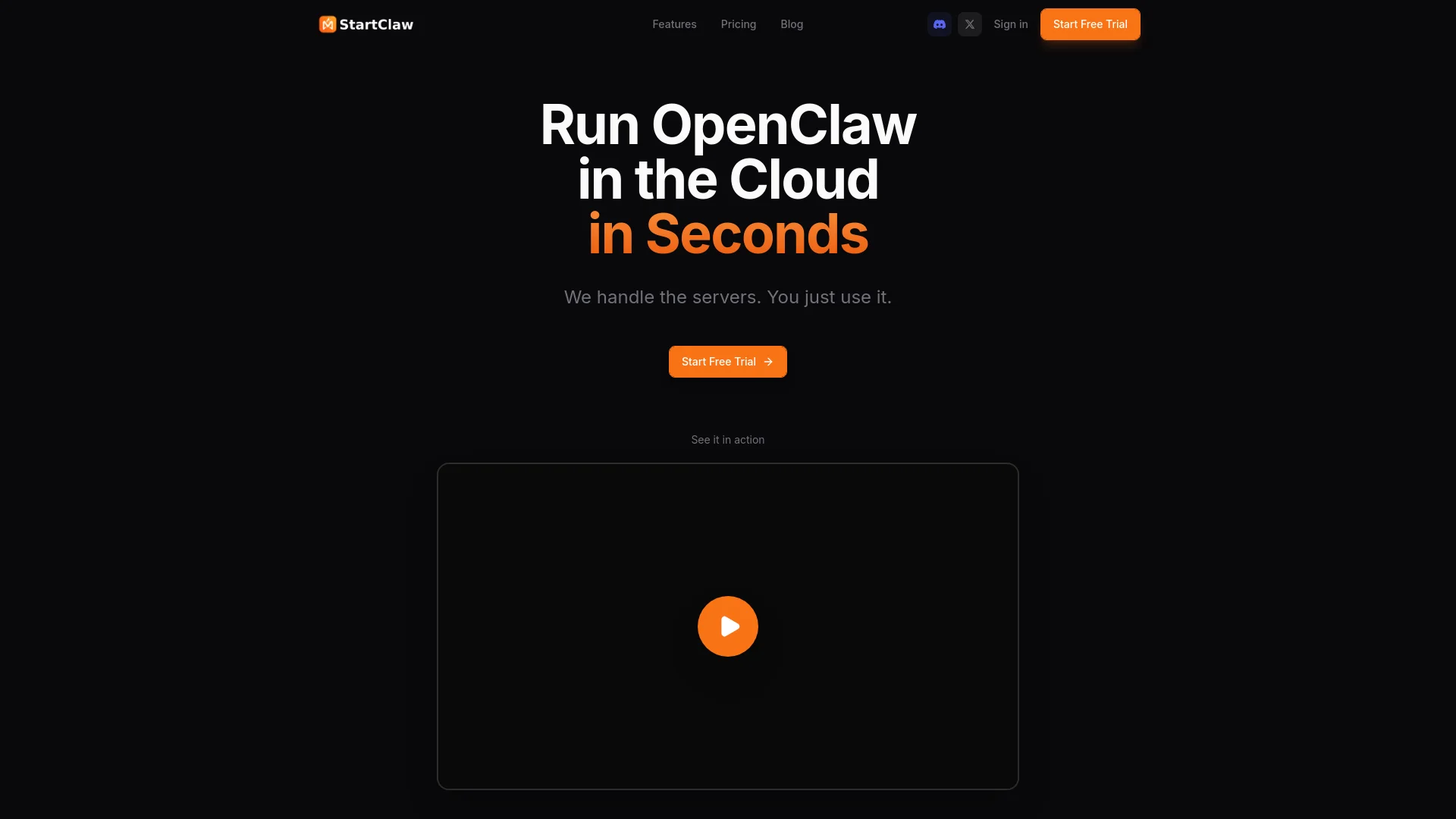
StartClaw is a cloud service for running OpenClaw AI agents. Official pages describe deploying agents quickly, connecting them to channels such as WhatsApp and Telegram, and keeping them running without you managing the servers yourself. It is hosted runtime infrastructure for agents, not a data-extraction or business-intelligence product. Builders can use it when they want a persistent agent online around the clock rather than a tool for analyzing datasets. StartClaw belongs with agentic foundations and multi-agent orchestration. People who already use or want OpenClaw can use a hosted option when they do not want to run the stack on their own machine.
Agent Capabilities
- AI browser automation for navigating and interacting with web pages autonomously
- Autonomous task execution with multi-step planning and error recovery
- Data processing and automation for extraction, transformation, and loading of structured data
- Live activity dashboard providing real-time visibility into agent actions and outcomes
- Mobile chat integration for initiating, monitoring, and controlling tasks from anywhere
- Bring your own API key to use preferred AI models with existing enterprise accounts
- Cloud-hosted solution with isolated infrastructure ensuring secure and compliant operations
- Automatic updates and quick deployment enabling rapid time-to-value without manual maintenance
Primary Workflows & Use Cases
- Automate cross-border e-commerce product catalog updates by scraping supplier sites and syncing inventory data
- Run performance creative testing by autonomously generating ad variations and collecting engagement metrics
- Support automated outbound sales by researching leads and sending personalized follow-up messages via chat
- Monitor software engineering pipelines and triage build failures by analyzing logs and notifying relevant teams
- Handle customer care triage by classifying incoming queries and routing them to appropriate resolution workflows
Similar Agentic Foundations & Multi-Agent Orchestration Agents
Explore alternatives and related autonomous systems in this category.
 MetaGPT
 is an open-source multi-agent framework that simulates a software company: a team of agents takes a natural-language requirement and produces artifacts such as plans, documents, and code. The public GitHub project, now under FoundationAgents, presents it as a framework for multi-agent collaboration and natural-language programming rather than as a hosted IDE. Researchers and developers use it to experiment with role-based agent teams, not to replace a production no-code app builder on its own. MetaGPT belongs with agentic foundations and orchestration, even though its demo domain is software delivery.
 xpander.ai
 is an enterprise platform for running and governing AI agents and coding tools in an organization’s own environment. Official pages describe an AI gateway, an MCP gateway, an agent runtime, and a workspace, including support for running popular coding agents in the customer’s cloud under one policy. Teams keep the tools they already use while IT keeps a single place for access, routing, and policy. That combination of gateway and runtime is agent infrastructure, not a generic digital-workforce product. xpander.ai belongs with agentic foundations.
 TinyFish
 is web infrastructure for AI agents that need to search, extract, browse, and act on live websites. Official pages describe an enterprise, serverless platform for navigating sites, authenticating, extracting data, and automating web workflows, including monitoring pages for changes. Developers use it as the web stack behind their agents rather than as a human operations console. TinyFish is a runtime and data layer for agents and belongs with agentic foundations. Official examples include monitoring live pages for price or content changes and then alerting an agent or team.
KaibanJS is a JavaScript framework for building multi-agent systems. Official materials describe managing agents with a Kanban-style board so developers can see and organize multi-agent runs in a way that feels familiar if they have used tools such as Trello or Jira. You define agents and their work in code, then watch those runs move across the board as they proceed. It is a programming library and visual board for agent orchestration in JavaScript applications, not a business-operations or digital-workforce product. KaibanJS belongs with agentic foundations, where other agent frameworks and orchestration tools are listed.
Community & Channels
Are you the author of StartClaw? Claim your official badge.