
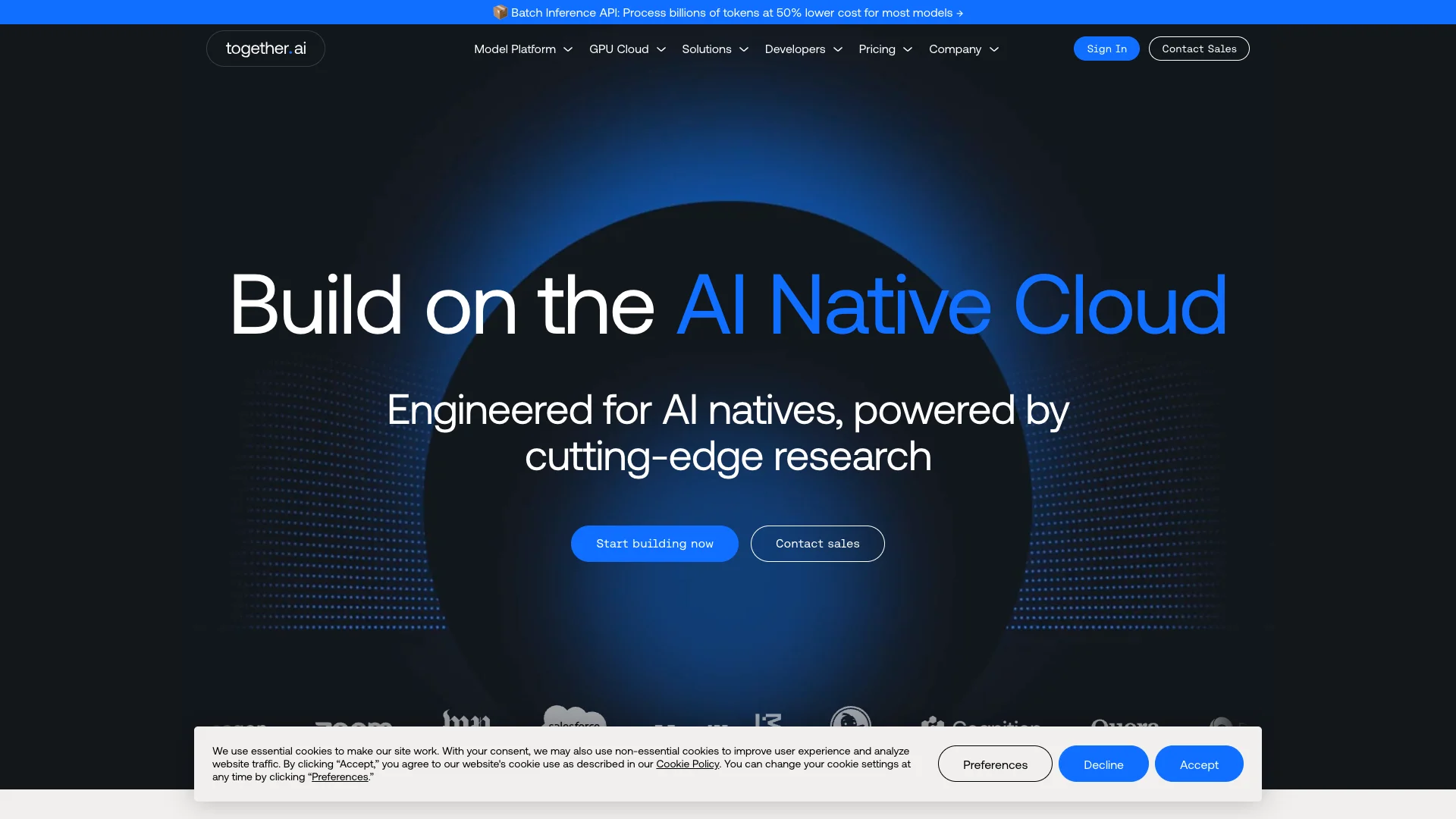
About This Agent
Serverless or dedicated inference, batch jobs, fine-tuning, and GPU clusters share one cloud for open models. Teams can serve a model as an API, reserve throughput, or run post-training without standing up their own cluster. The company also publishes work on compilers, kernels, and a way to run those models inside an existing harness.
Agent Capabilities
- Serverless Inference API with automatic scaling and pay-per-token pricing for cost-efficient production workloads.
- Fine-Tuning Platform supporting LoRA and full-parameter tuning on open-source models with one-click dataset integration.
- Curated Model Library featuring leading open-weight models like Llama 3, Mistral, and Mixtral, with versioned endpoints.
- Pre-Training Capabilities on massive-scale GPU clusters with fault-tolerant distributed training orchestration.
- Instant GPU Clusters provisioned in seconds, offering flexible configurations from A100s to H100s and next-gen hardware.
- Dedicated Endpoints for guaranteed throughput and low latency, ideal for mission-critical applications.
- Global Data Center Network ensuring data residency compliance and reduced inference latency across regions.
- Integrated Code Sandbox and Code Interpreter for rapid prototyping, testing, and reproducible model evaluation.
Primary Workflows & Use Cases
- Generate and localize product catalogs for cross-border e-commerce using fine-tuned multilingual models, reducing manual translation effort by 70%.
- Run performance creative testing by generating hundreds of ad variations and predicting engagement metrics, accelerating campaign iteration cycles from weeks to days.
- Deploy automated outbound sales agents that personalize outreach sequences based on prospect behavior, increasing response rates by 35%.
- Enhance software engineering pipelines with code generation, review, and documentation assistants, cutting development time for routine tasks by 40%.
- Automate customer care triage with intent classification and real-time summarization, reducing average handling time by 25% and improving CSAT scores.
Similar Agentic Foundations & Multi-Agent Orchestration Agents
Explore alternatives and related autonomous systems in this category.
 MetaGPT
Different GPT roles form a software-company-style team that takes a one-line requirement and works through plans, documents, and code. The public docs at docs.deepwisdom.ai present MetaGPT as a multi-agent framework for assigning those roles and orchestrating the collaboration. It is tooling for people experimenting with LLM agents in a role-based setup, not a hosted app builder you log into.
 xpander.ai
 is an enterprise platform for running and governing AI agents and coding tools in an organization’s own environment. Official pages describe an AI gateway, an MCP gateway, an agent runtime, and a workspace, including support for running popular coding agents in the customer’s cloud under one policy. Teams keep the tools they already use while IT keeps a single place for access, routing, and policy. That combination of gateway and runtime is agent infrastructure, not a generic digital-workforce product. xpander.ai belongs with agentic foundations.
 TinyFish
 is web infrastructure for AI agents that need to search, extract, browse, and act on live websites. Official pages describe an enterprise, serverless platform for navigating sites, authenticating, extracting data, and automating web workflows, including monitoring pages for changes. Developers use it as the web stack behind their agents rather than as a human operations console. TinyFish is a runtime and data layer for agents and belongs with agentic foundations. Official examples include monitoring live pages for price or content changes and then alerting an agent or team.
KaibanJS is a JavaScript framework for building multi-agent systems. Official materials describe managing agents with a Kanban-style board so developers can see and organize multi-agent runs in a way that feels familiar if they have used tools such as Trello or Jira. You define agents and their work in code, then watch those runs move across the board as they proceed. It is a programming library and visual board for agent orchestration in JavaScript applications, not a business-operations or digital-workforce product. KaibanJS belongs with agentic foundations, where other agent frameworks and orchestration tools are listed.
Community & Channels
Are you the author of Together AI? Claim your official badge.