
About This Agent
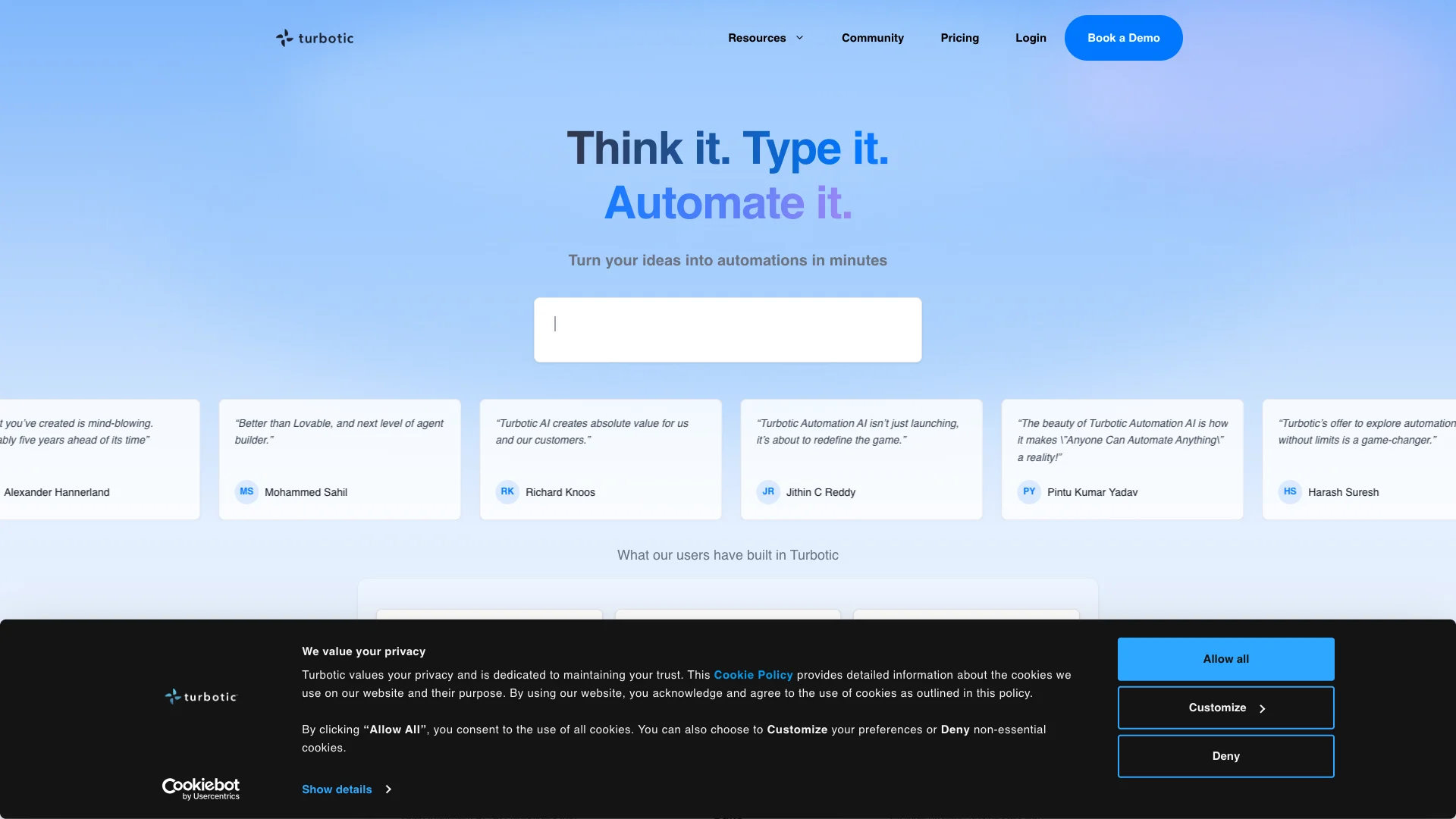
Turbotic is an enterprise-grade AI agent platform engineered to automate complex business processes end-to-end. Its core architecture combines large language model reasoning with workflow orchestration, enabling autonomous execution of tasks across finance, operations, and administrative domains. The platform ingests unstructured data from invoices, receipts, and financial documents, then applies AI-assisted accounting to classify, validate, and post transactions with minimal human intervention. It eliminates manual data entry, reconciliation delays, and process bottlenecks by providing intelligent recommendations for process optimization and transformation roadmapping. Built on a foundation of strict data isolation and industry compliance certifications, Turbotic ensures security and regulatory adherence for finance and operations teams. Concrete use cases include automating expense report audits for multinational corporations, streamlining invoice-to-payment cycles for procurement departments, and orchestrating cross-departmental workflows such as vendor onboarding or month-end close. Organizations typically achieve a 60-80% reduction in processing time and a 40-50% decrease in operational costs, while improving accuracy and auditability. The platform also supports continuous process analysis, identifying inefficiencies and suggesting actionable improvements, making it a strategic asset for digital transformation initiatives.
Agent Capabilities
- Autonomous expense management automation with real-time policy enforcement and anomaly detection
- AI-driven invoice and payment processing that extracts, validates, and routes financial documents
- AI-assisted accounting with automatic ledger classification and reconciliation
- Business process orchestration across finance, HR, and operations with human-in-the-loop checkpoints
- Process analysis and optimization using machine learning to identify bottlenecks and waste
- AI-powered recommendations for workflow improvements and cost-saving opportunities
- Transformation roadmapping that prioritizes automation initiatives based on ROI and risk
- Enterprise-grade infrastructure with data isolation, role-based access, and audit trails
- Industry compliance certifications including SOC 2, ISO 27001, and GDPR readiness
Primary Workflows & Use Cases
- Automate end-to-end expense report processing for global sales teams, reducing approval cycles from days to hours
- Streamline invoice-to-payment workflows for procurement departments, cutting manual data entry and payment errors
- Orchestrate month-end close processes across finance, reducing close time by 50% and improving audit readiness
- Enable AI-assisted reconciliation for multi-entity subsidiaries, ensuring accurate intercompany transactions
- Provide transformation roadmaps for finance leaders to prioritize automation initiatives based on operational impact
Similar Software Engineering & DevAgents Agents
Explore alternatives and related autonomous systems in this category.
Effie is an AI-powered writing and ideation platform engineered to streamline the entire content lifecycle, from initial concept to polished output. Its core architecture integrates a context-aware language model that assists with content generation, refinement, and stylistic correction, while a dedicated brainstorming module structures raw thoughts into coherent outlines. The system eliminates operational friction associated with context switching and tool fragmentation by providing a distraction-free, minimalist canvas that supports Markdown, enabling writers, product managers, and knowledge workers to maintain deep focus. Effie ensures continuity across devices through robust cloud synchronization and a fully functional offline mode, making it reliable for remote and field-based teams. For cross-border e-commerce teams, Effie accelerates the drafting of localized product descriptions and SEO-optimized listings. Performance creative teams can rapidly iterate on ad copy variations and tone adjustments. In software engineering pipelines, Effie aids in generating technical documentation and API usage guides. Customer care triage benefits from templated response refinement and tone normalization. By reducing drafting time by up to 40% and cutting editing cycles by half, Effie delivers measurable productivity gains across content-heavy workflows.
LoreKeeper is an AI-native knowledge orchestration agent designed to structure, retrieve, and operationalize unstructured institutional memory across distributed enterprise systems. Its core architecture combines a retrieval-augmented generation (RAG) engine with a semantic graph layer, enabling the agent to map relationships between documents, codebases, customer interactions, and operational logs. LoreKeeper eliminates the friction of manual knowledge base curation by automatically ingesting content from disparate sources, deduplicating entities, and generating context-aware summaries that are versioned and auditable. It addresses critical pain points such as information silos, stale documentation, and slow onboarding by providing a unified query interface that returns cited, role-specific answers. In cross-border e-commerce, LoreKeeper can harmonize product catalogs across regional compliance standards. For software engineering pipelines, it can trace architectural decisions from pull requests to incident post-mortems. In customer care, it triages recurring issues by linking symptom patterns to known resolutions. Typical deployments report a 60% reduction in time spent searching for internal knowledge and a 40% acceleration in new hire ramp-up, with measurable gains in cross-team consistency and decision latency.
 MetaGPT
MetaGPT is an open-source multi-agent framework that simulates a software company to translate natural language product requirements into functional code, documentation, and task artifacts. Its core architecture assigns distinct roles—such as product manager, architect, project manager, and engineer—to autonomous agents that collaborate through a structured message pool and a shared knowledge base, enabling dynamic workflow orchestration and process management. This eliminates the friction of manual requirement handoffs, inconsistent documentation, and fragmented toolchains that typically slow down software delivery. By supporting agent creation and customization, teams can tailor agent behaviors to specific domain conventions, while the built-in agent management layer ensures traceability and governance across complex projects. MetaGPT is particularly valuable for accelerating MVP prototyping, generating API specifications, automating code review, and producing user stories and acceptance criteria. It also serves vertical use cases such as generating localized e-commerce catalog backends, creating test scripts for performance creative variants, drafting outbound sales sequence logic, and triaging customer care tickets into structured workflows. Organizations using MetaGPT report up to 80% reduction in initial design-to-code turnaround time and a 50% decrease in requirement misinterpretation, making it a strategic asset for lean engineering teams and enterprise innovation groups.
 Epsilla
Epsilla is an enterprise-grade platform for building and deploying custom AI agents without coding or complex infrastructure setup. It provides a visual, no-code builder that abstracts the underlying agent architecture, including orchestration, memory management, and tool integration, enabling rapid assembly of production-ready agents. The platform integrates Retrieval-Augmented Generation (RAG) as a managed service, allowing agents to ground responses in proprietary knowledge bases with automatic chunking, embedding, and vector search. Epsilla eliminates operational friction around scaling, security, and maintenance by offering scalable infrastructure with enterprise-grade multi-tenancy and flexible deployment options, including cloud, on-premises, and VPC. This reduces the need for dedicated ML engineering teams and accelerates time-to-value. Concrete use cases include automating cross-border e-commerce catalog enrichment and translation, running performance creative testing for ad campaigns, powering automated outbound sales sequences with personalized messaging, supporting software engineering pipelines with code-aware Q&A, and triaging customer care tickets. Organizations typically see a 60-80% reduction in agent development time and a 40% decrease in support response times.
Community & Channels
Are you the author of Turbotic? Claim your official badge.