
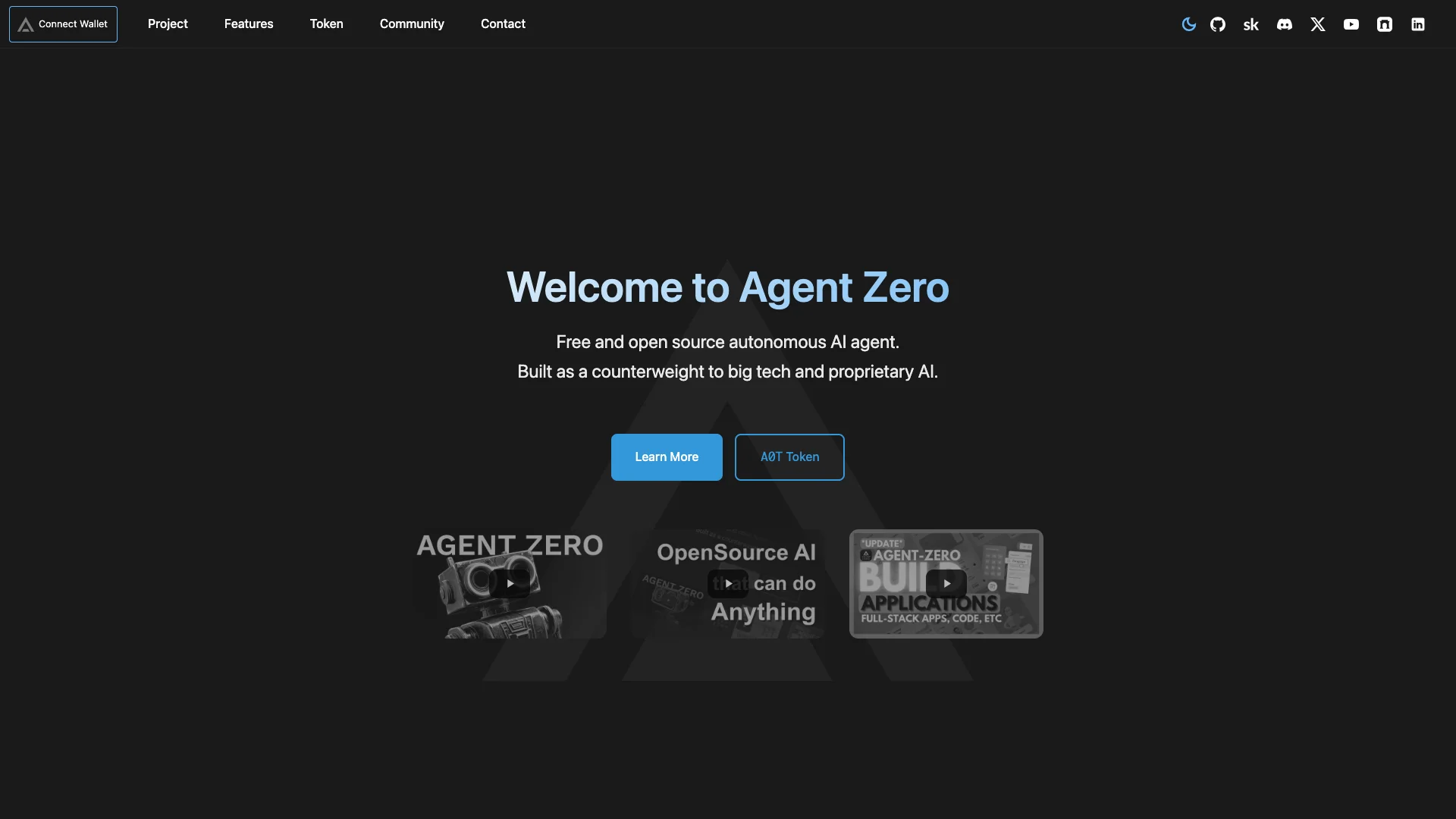
About This Agent
Agent Zero is an open-source agentic framework and computer assistant. Official pages describe a system you can run as a general-purpose agent that uses tools, code, and a computer environment rather than a single-purpose business app. It is a foundation for building and running agents, already filed under agentic foundations. Developers and researchers can use it when they want a self-hosted agent framework they can inspect and extend, not a closed vertical product. The current category already matches that official positioning.
Agent Capabilities
- Runs in a self-contained virtual Linux environment, eliminating external infrastructure dependencies
- Autonomously creates and deploys custom tools for task-specific requirements
- Executes dynamic code in real time, enabling adaptive problem-solving without human intervention
- Integrated web browsing with private search capabilities, preserving data confidentiality
- Multi-agent cooperation framework for parallel task decomposition and execution
- Advanced persistent memory system that retains context across sessions and tasks
- Fully extensible open-source foundation, allowing deep customization and integration
- Unrestricted operation mode, supporting complex, multi-step workflows without sandboxing limits
Primary Workflows & Use Cases
- Automate cross-border e-commerce product catalog creation, including multilingual descriptions and SEO metadata generation
- Run performance creative A/B tests by dynamically generating ad variants and analyzing engagement metrics in real time
- Execute automated outbound sales sequences, including lead research, personalized email drafting, and follow-up scheduling
- Streamline software engineering pipelines by auto-generating unit tests, debugging code, and managing CI/CD tasks
- Triage customer care tickets by categorizing issues, drafting responses, and escalating critical cases to human agents
Similar Agentic Foundations & Multi-Agent Orchestration Agents
Explore alternatives and related autonomous systems in this category.
 MetaGPT
Different GPT roles form a software-company-style team that takes a one-line requirement and works through plans, documents, and code. The public docs at docs.deepwisdom.ai present MetaGPT as a multi-agent framework for assigning those roles and orchestrating the collaboration. It is tooling for people experimenting with LLM agents in a role-based setup, not a hosted app builder you log into.
 xpander.ai
 is an enterprise platform for running and governing AI agents and coding tools in an organization’s own environment. Official pages describe an AI gateway, an MCP gateway, an agent runtime, and a workspace, including support for running popular coding agents in the customer’s cloud under one policy. Teams keep the tools they already use while IT keeps a single place for access, routing, and policy. That combination of gateway and runtime is agent infrastructure, not a generic digital-workforce product. xpander.ai belongs with agentic foundations.
 TinyFish
 is web infrastructure for AI agents that need to search, extract, browse, and act on live websites. Official pages describe an enterprise, serverless platform for navigating sites, authenticating, extracting data, and automating web workflows, including monitoring pages for changes. Developers use it as the web stack behind their agents rather than as a human operations console. TinyFish is a runtime and data layer for agents and belongs with agentic foundations. Official examples include monitoring live pages for price or content changes and then alerting an agent or team.
KaibanJS is a JavaScript framework for building multi-agent systems. Official materials describe managing agents with a Kanban-style board so developers can see and organize multi-agent runs in a way that feels familiar if they have used tools such as Trello or Jira. You define agents and their work in code, then watch those runs move across the board as they proceed. It is a programming library and visual board for agent orchestration in JavaScript applications, not a business-operations or digital-workforce product. KaibanJS belongs with agentic foundations, where other agent frameworks and orchestration tools are listed.
Community & Channels
Are you the author of Agent Zero? Claim your official badge.