
About This Agent
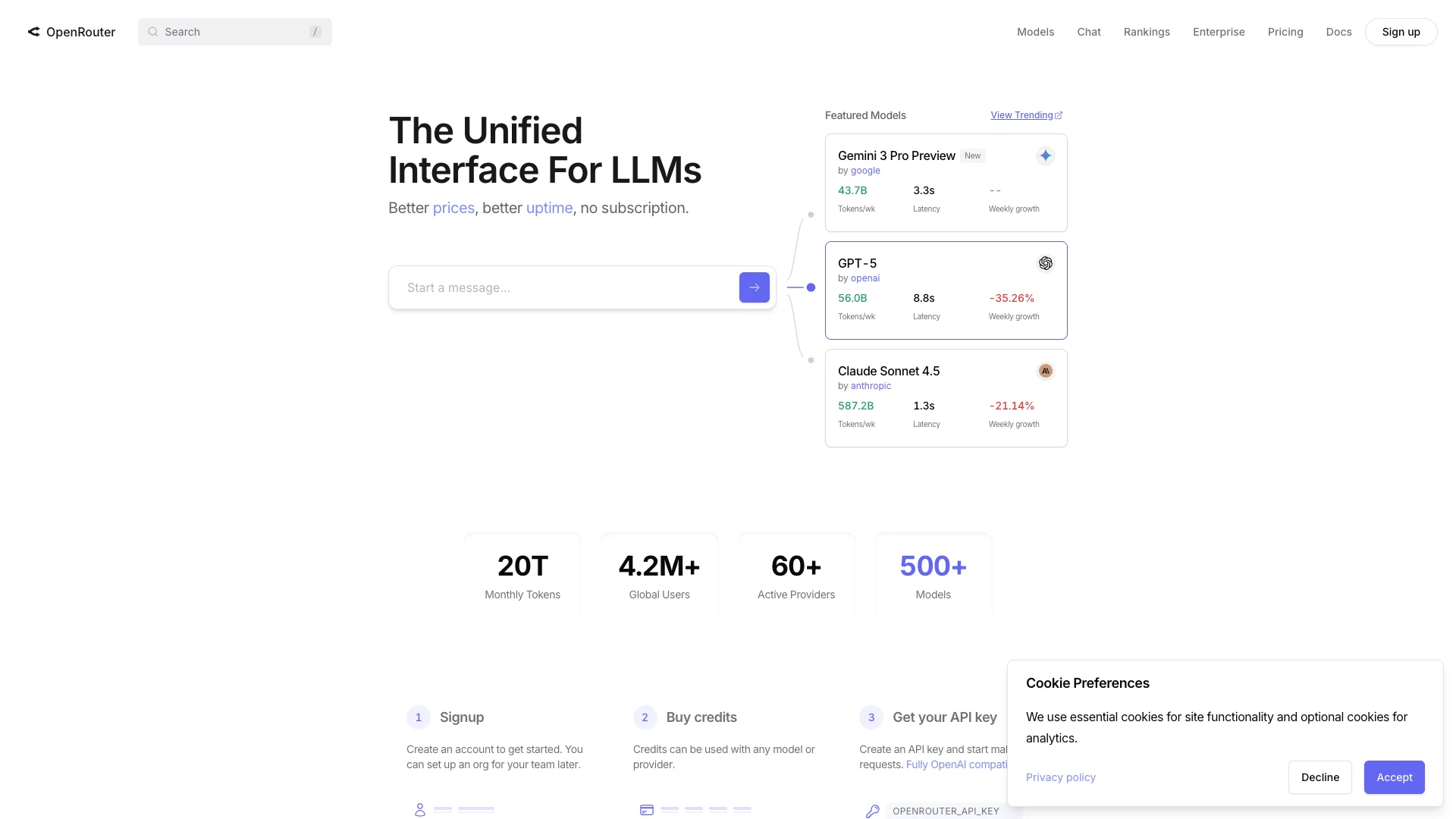
OpenRouter is a unified AI inference gateway that provides a single API endpoint to access a broad catalog of large language models from multiple providers, including OpenAI, Anthropic, Google, and open-source alternatives. It is engineered to eliminate the operational friction of managing multiple vendor SDKs, authentication schemes, and rate limits by offering an OpenAI-compatible interface that requires minimal code changes for integration. The platform performs intelligent, cost-aware routing to select the optimal model for each request based on latency, price, and reliability, while also providing automatic failover to maintain high availability. It leverages edge-optimized infrastructure to reduce response times globally. OpenRouter addresses critical pain points such as vendor lock-in, unpredictable API costs, and inconsistent model performance. Enterprises can use it to build robust AI pipelines that require model diversity, such as dynamic content generation for cross-border e-commerce catalogs, A/B testing of performance creative variants, automated outbound sales sequencing, and code review automation in software engineering workflows. By abstracting model complexity, OpenRouter reduces integration time by up to 80% and lowers inference spend by up to 50% through intelligent routing, making it a strategic layer for production-grade AI deployments.
Agent Capabilities
- Unified API access to 300+ models from leading and emerging providers with a single authentication key.
- OpenAI SDK compatibility enables drop-in replacement for existing OpenAI integrations without code rewrites.
- Intelligent cost-based routing automatically selects the most economical model that meets performance thresholds.
- High-availability architecture with automatic failover and redundant provider connections ensures minimal downtime.
- Edge-optimized inference delivery reduces latency by routing requests to the nearest available compute region.
- Custom data policies allow enterprises to restrict traffic to providers that meet specific data residency and privacy requirements.
- Trusted provider control lets users whitelist or blacklist specific model providers for compliance and governance.
- Comprehensive model exploration tools include interactive playgrounds, performance benchmarks, and side-by-side comparisons.
- Real-time performance and usage rankings provide visibility into model speed, reliability, and cost metrics.
Primary Workflows & Use Cases
- Automate multilingual product description generation for cross-border e-commerce catalogs with dynamic model selection based on language and cost.
- Run high-throughput A/B tests of performance creative variations across ad platforms, using different models to generate copy and measure engagement.
- Power automated outbound sales sequences that draft personalized email and LinkedIn messages, with fallback models to ensure deliverability.
- Integrate into CI/CD pipelines for automated code review and bug triage, routing complex analysis to premium models and simple tasks to budget models.
- Deploy customer care triage bots that classify intent and escalate to human agents, using cost-effective models for routine queries.
Similar Agentic Foundations & Multi-Agent Orchestration Agents
Explore alternatives and related autonomous systems in this category.
 Haystack
Haystack is an open-source AI framework engineered for building production-grade applications and agents. It provides a modular architecture for orchestrating complex agent workflows, enabling developers to design, deploy, and scale AI systems with precision. The framework eliminates the friction of integrating disparate AI components by offering a unified development and deployment environment that supports advanced Retrieval-Augmented Generation (RAG) pipelines, multimodal inputs, and extensive integrations across the AI stack. Haystack's visual pipeline editor and multi-pipeline experimentation capabilities streamline iterative development, reducing time-to-production for sophisticated AI solutions. It is built for enterprise scalability, with private support options for organizations requiring strict data governance. By abstracting infrastructure complexities, Haystack allows teams to focus on logic and outcomes, cutting development cycles by up to 40%. Use cases span cross-border e-commerce catalog enrichment, automated performance creative testing, outbound sales sequence optimization, software engineering code review automation, and customer care triage. Whether you are prototyping a proof-of-concept or deploying a mission-critical system, Haystack provides the control, transparency, and reliability required for high-stakes AI operations.
 Gumloop
Gumloop is a no-code AI agent platform that enables teams to design, deploy, and manage complex automation workflows through a visual drag-and-drop interface. The core architecture combines a powerful visual builder with event-driven execution and AI-enhanced decision making, allowing users to construct pipelines that integrate large language models, custom logic, and external data sources without writing code. The platform includes extensive AI nodes for tasks such as data analysis, intelligent categorization, and dynamic routing, which adapt workflow paths based on real-time inputs. With 115+ native integrations and support for custom database connectivity, Gumloop eliminates the friction of manual data orchestration and API glue code. It addresses operational pain points like repetitive data entry, slow document processing, and fragmented tool chains. Concrete use cases include automating cross-border e-commerce catalog enrichment, orchestrating performance creative testing across ad platforms, triggering personalized outbound sales sequences, streamlining software engineering ticket triage, and enhancing customer care with automated response routing. By reducing manual effort and enabling parallel processing, Gumloop delivers measurable productivity gains, often cutting workflow turnaround times by up to 80% and freeing teams to focus on higher-value strategic tasks.
 Pydantic AI
Pydantic AI is a Python agent framework designed for building production-grade GenAI applications with a focus on type safety and developer efficiency. At its core, it leverages Pydantic models to define agent behaviors, tools, and structured outputs, ensuring that every interaction is validated and type-checked at compile time. This eliminates common runtime errors and reduces debugging overhead, accelerating development cycles. The framework supports graph-based workflows for complex, multi-step processes, durable execution for fault tolerance, and human-in-the-loop approval gates for critical actions. It is model-agnostic, allowing seamless integration with various LLMs, and includes built-in observability via Logfire for monitoring and tracing. Pydantic AI addresses operational pain points such as unreliable outputs, lack of workflow control, and poor integration with existing systems. It enables concrete use cases like automated cross-border e-commerce catalog generation with consistent data schemas, performance creative testing with structured feedback loops, and customer care triage with escalation workflows. By reducing boilerplate code and enforcing type safety, teams can achieve up to 40% faster agent development and a 30% reduction in production incidents.
 Flowise
Flowise is an open-source, low-code platform engineered for the visual orchestration of AI agents and chatbots. Its core architecture employs a drag-and-drop canvas that abstracts the complexity of LangChain and LangGraph, enabling developers and technical operators to design, prototype, and deploy agentic workflows without writing boilerplate glue code. The platform supports single-agent task automation and multi-agent orchestration, where specialized sub-agents collaborate under a supervisor to handle complex, sequential reasoning. Flowise eliminates the operational friction of managing prompt templates, vector database integrations, and model API switches by providing pre-built nodes and ready-to-use templates. It also incorporates human-in-the-loop checkpoints, allowing domain experts to approve or correct outputs before execution, which is critical for regulated industries. Deployable on-premises, in a private cloud, or via Kubernetes, Flowise scales from proof-of-concept to production with built-in monitoring and logging. Typical long-tail use cases include automating cross-border e-commerce catalog enrichment, generating and A/B testing performance creative variants, powering outbound sales qualification sequences, accelerating software engineering documentation pipelines, and triaging customer care tickets with sentiment analysis. Teams report up to 80% faster agent prototyping and a 60% reduction in integration development time compared to code-first frameworks.
Community & Channels
Are you the author of OpenRouter? Claim your official badge.